
Seongsu Travel Guide 2026
Seongsu is one of the easiest Seoul neighborhoods to plan badly.
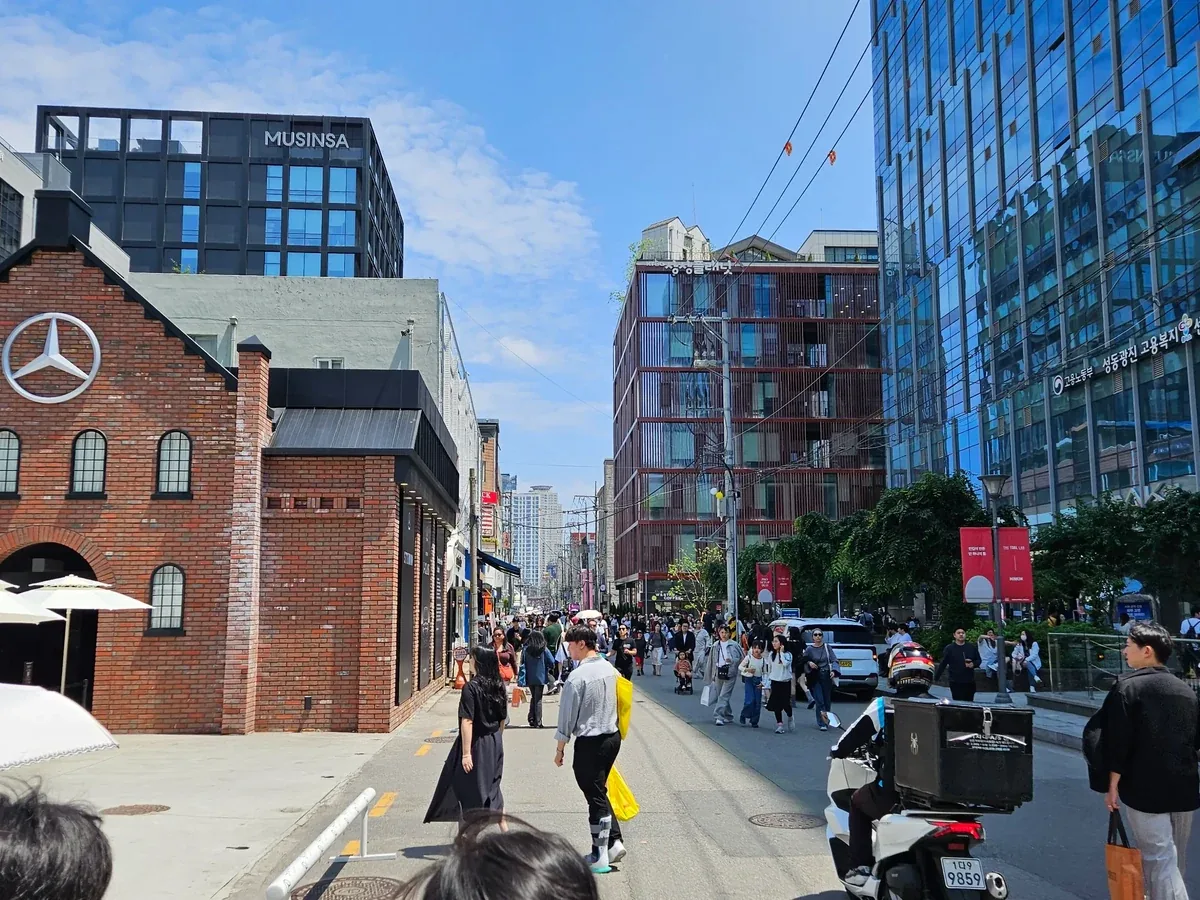
A café you saved six months ago may still be there. The pop-up beside it may be gone next week. A street that looks quiet in the morning can be packed by mid-afternoon, and a 20-minute stop can become an hour if you join a queue without deciding whether you actually care what is at the end of it.
The useful way to visit Seongsu is to separate the neighborhood into two layers.
Build the day around places that will still be there. Treat pop-ups as the variable layer.
Start with the streets, permanent shops, beauty spaces, industrial architecture or Seoul Forest that made you choose Seongsu in the first place.
Then check what is happening during your actual dates.
That order keeps a trend-focused neighborhood from turning into a day spent chasing expired Instagram posts.
What Seongsu Is Actually Good For
Seongsu works because several versions of Seoul overlap in the same neighborhood.
The older version is still visible in shoe workshops, factory buildings, warehouses and industrial streets.
The newer version fills those spaces with fashion, beauty, cafés, flagship stores, design and short-term brand events.
That combination matters more than any single famous café.
Seongsu still combines former shoe-factory traces and industrial buildings with modern stores, galleries and pop-ups. Seongsu Handmade Shoes Street also remains an active manufacturing district rather than a historical name left on a map.
Come here when discovery is part of the day
Seongsu is stronger for travelers who enjoy finding things as they walk.
You can arrive with two or three fixed places and still leave room for something you did not know existed before that afternoon.
That is different from a palace day, where the main destinations are known before you leave the hotel.
In Seongsu, the street itself keeps changing.
A new beauty launch, fashion collaboration or small exhibition may sit between two permanent stores.
The flexibility is part of the attraction.
The neighborhood is especially strong for fashion and beauty
This is no longer simply Seoul's warehouse-café district.
OLIVE YOUNG N Seongsu now operates near Seongsu Station with skin and scalp consultations, skin-color analysis and rotating pop-up content in addition to shopping. The store is currently about 100 meters from Seongsu Station Exit 4 and operates 10:00–22:00.
That makes Seongsu useful when you are interested in how Korean beauty brands are being presented now, not only in buying products.
Fashion works in a similar way.
Large permanent spaces, Korean brands, international flagships and temporary collaborations all compete for attention in a relatively small part of the neighborhood.
It is weaker when you want a fixed sightseeing checklist
If your preferred travel day is:
attraction A → attraction B → attraction C
Seongsu can feel inefficient.
A queue may change the timing. A pop-up may require a reservation. A store you expected to spend 30 minutes in may deserve five.
Or none of it may interest you once you see it.
That is normal here.
The solution is not to build a more complicated checklist.
It is to arrive with fewer fixed commitments.
Seongsu does not need to fill an entire day
For many first-time visitors, a strong half day is enough.
You can experience the industrial streets, choose a few shops or beauty spaces, have one café break and finish around Seoul Forest without turning Seongsu into an endurance test.
A full day makes more sense when fashion, K-beauty, design or pop-ups are major interests.
If they are not, Seongsu may be one part of your Seoul trip rather than its centerpiece.
Start With the Time You Actually Have
The easiest way to overload Seongsu is to underestimate how much time browsing takes.
The distances do not always look large.
The friction comes from stopping.
One pop-up, one cosmetics store, one flagship and one café can quietly consume most of the afternoon.
If you have about three hours
Keep one side of Seongsu as the priority.
A trend-focused version might be:
Seongsu Station → Yeonmujang-gil → one or two stores or pop-ups → café or meal
A park-focused version might be:
Seoul Forest → nearby streets → one flagship or café
Three hours is not enough for serious pop-up hunting, several beauty spaces, a long café queue and a relaxed Seoul Forest walk.
Something has to stay out.
If you have half a day
This is the easiest range for a first visit.
You have enough time to see why Seongsu feels different without needing to rush every stop.
A practical rhythm is:
Seongsu Station → Yeonmujang-gil → selected shopping / pop-ups → proper break → continue toward Seoul Forest
The important word is selected.
Do not make a list of ten stores simply because they are all within walking distance.
Choose the places that match your interests and let the rest compete for your attention when you actually pass them.
If you have most of a day
Then the neighborhood can breathe.
You can spend more time with beauty or fashion, include one meaningful café, understand some of the industrial context and use Seoul Forest as a real break rather than a final photo stop.
This is also the version that gives pop-ups room.
If one temporary event has a queue or timed entry, the entire itinerary does not collapse.
But even with a full day, there is no reason to visit every trending place.
More time should create more flexibility.
It should not create a larger checklist.
Weekends change the calculation
A location that takes 20 minutes on a quiet weekday can take much longer when there is a queue outside.
That matters most for temporary pop-ups, new flagships and viral cafés.
If there is one place you genuinely care about, put it earlier.
Leave the optional stops for later.
The worst use of Seongsu time is spending an hour waiting for something you did not care about until you saw everyone else waiting.
Seongsu is not only a place to browse stores and pop-ups. Some of the neighborhood's better activities give you something to make, test or understand rather than another bag to carry.
The trade-off is time. Once you book a fixed session, it becomes one of the anchors of the day. Treat it as a replacement for another flagship or pop-up block, not something to stack on top of an already full route.
One booked experience is usually enough
A skincare class, personal color session or perfume workshop can each make sense.
Doing all three usually does not.
Pick the one that best matches what you already came to Seongsu for, then let the neighborhood stay flexible around it.
Where to Start: Seongsu Station or Seoul Forest?
There is no single correct entrance to Seongsu.
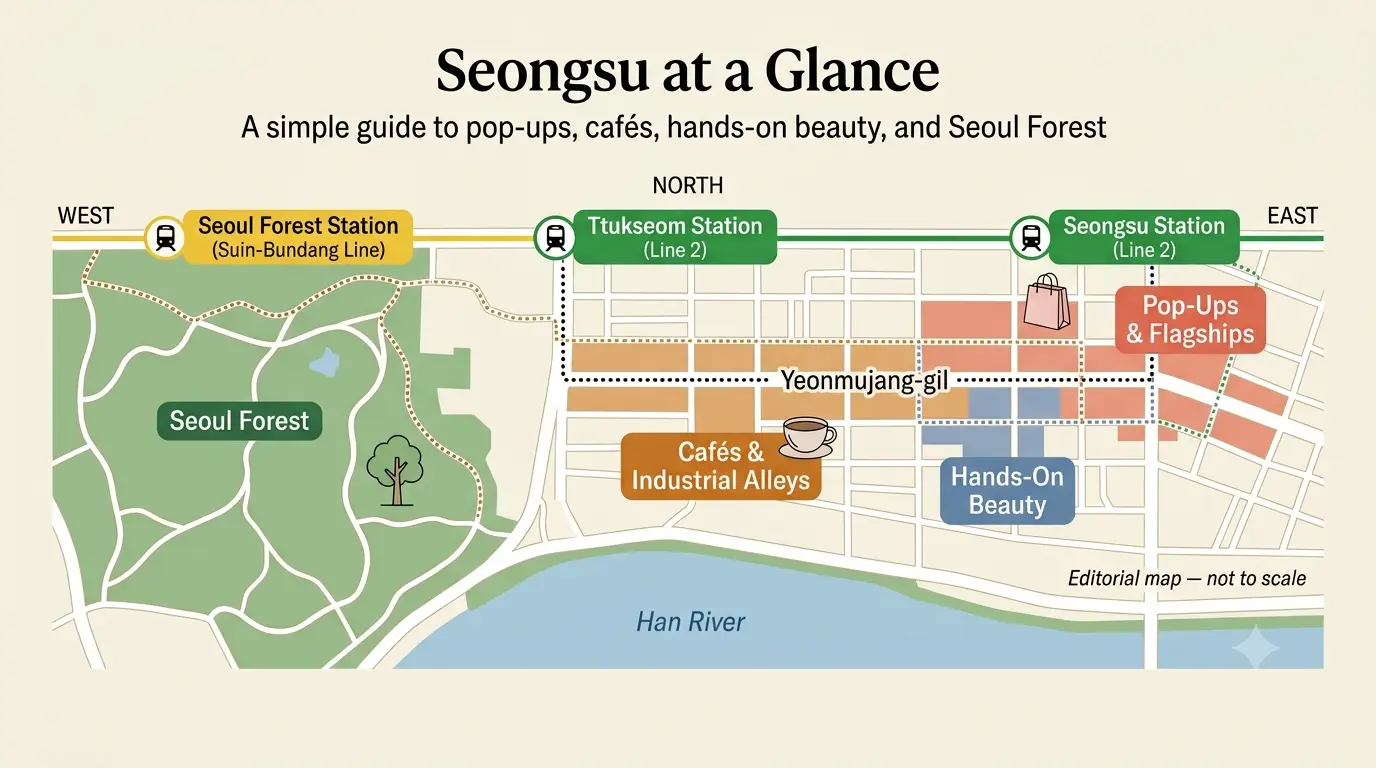
The useful starting point depends on which version of the neighborhood you want first.
Start at Seongsu Station when trends are the priority
For most first-time visitors focused on shopping, pop-ups, beauty and the industrial streets, Seongsu Station is the easier default.
Yeonmujang-gil is currently listed about 533 meters from Exit 3, while OLIVE YOUNG N Seongsu is about 100 meters from Exit 4.
That puts you close to the part of Seongsu where temporary and permanent retail overlap most heavily.
From here, the day can gradually move west and south rather than beginning at the park and repeatedly backtracking for stores.
Start at Seoul Forest when the park is the priority
If Seoul Forest is one of the main reasons you came, reverse the logic.
Start on the park side while you still have the energy and weather for it.
Seongsu Station is on Line 2, while Seoul Forest Station is on the Suin–Bundang Line (Exits 3/4). If you are already traveling on Line 2 and want to visit the park first, Ttukseom Station Exit 8 is another practical way to reach Seoul Forest. Check your existing subway route before adding a transfer just for the station name.
Then move toward Seongsu's denser commercial streets.
This works particularly well when you want the day to become busier rather than quieter.
The park can be the open-air first half.
Shopping and cafés become the second.
Do not cross the neighborhood just for the name of a station
It is easy to assume that everyone visiting Seongsu should exit at Seongsu Station because the neighborhood is called Seongsu.
That is no more useful than assuming every Myeongdong visit must begin at Myeongdong Station.
Look at the day you actually planned.
If your first meaningful stop is near Seoul Forest, start there.
If most of your saved places sit around Yeonmujang-gil and Seongsu Station, start on that side.
The subway is the entrance.
It is not the itinerary.
One-way routes work better than repeated backtracking
A simple first-time pattern is:
Seongsu Station → Yeonmujang-gil → selected flagships / pop-ups → café or meal → Seoul Forest
The reverse works when the park matters more.
Either is better than:
station → shop → park → back to shop → different café → back toward park
because the map looked compact.
Seongsu is walkable.
That does not mean repeated walking is free.
Understand Yeonmujang-gil Before You Wander
Yeonmujang-gil is one of the best places to understand why modern Seongsu looks the way it does.
The street is not simply a row of trendy stores.
Traces of former shoe factories and industrial buildings now coexist here with cafés, galleries, clothing shops and brand pop-ups. Check active pop-up dates before visiting because the temporary layer changes.
That is almost a summary of Seongsu itself.

Use the street as a spine, not a checklist
You do not need to enter everything along Yeonmujang-gil.
Use the street to connect the places you actually care about.
If a new store catches your attention, go in.
If a queue has formed for a brand you have never heard of and do not care about, keep walking.
The crowd is information.
It is not an instruction.
Look at the buildings as well as the brands
Part of Seongsu's appeal comes from the physical spaces.
High ceilings, exposed brick, old factory proportions and warehouse layouts are not decorative themes invented for tourists.
They come from the district's industrial history.
That history is still visible in places such as the handmade-shoe district, while newer retail spaces deliberately preserve parts of older structures.
Musinsa Store Seongsu @ Daelim Changgo, for example, retains the structure of the long-standing Daelim Warehouse rather than replacing it with a conventional shopping interior.
This is why a fashion store in Seongsu can feel different from the same brand inside a department store.
The building is part of the experience.
Do not confuse permanent landmarks with temporary content
This distinction will save you a lot of planning problems.
Yeonmujang-gil will still exist.
Daelim Warehouse is part of the permanent neighborhood fabric.
The shoe-manufacturing history is not disappearing next week.
A branded installation inside another building may close before your flight lands.
Build the itinerary around the first group.
Use the second group to customize the day.
Give yourself permission to change the plan
This is one neighborhood where changing the plan is often the correct decision.
You may find a pop-up that matters more than the store you saved.
You may discover the café queue is longer than the café is worth.
You may reach Seoul Forest later than expected and decide that 40 minutes there is enough.
That does not mean the itinerary failed.
It means you used Seongsu the way the neighborhood actually works.
Pop-Ups: Check Dates, Not Old Lists
Pop-ups are part of the reason Seongsu feels current.
They are also the easiest part of a Seongsu itinerary to get wrong.
A store featured in a video from last month may already be gone. A collaboration you saved may finish two days before you arrive. Another event may still be running but require a reservation, waiting list or timed entry.
The useful question is not:
“What are the best pop-ups in Seongsu?”
It is:
“What is actually open during my dates, and do I care enough to spend time on it?”
Check your dates before you build the route
Build the evergreen part of the day around permanent places.
Then check current pop-ups shortly before the trip.
For each one, confirm:
- opening and closing dates
- daily hours
- reservation or waiting rules
- whether entry is free
- whether the event is mainly shopping, exhibition or an interactive experience
A beautiful saved post does not tell you any of those things.
Some pop-ups are activities, not just temporary shops
Some Seongsu pop-ups are worth time even when shopping is not the main reason you entered. Depending on the event, the visit may include product testing, games, photo zones, samples, DIY elements or limited goods. In those cases, the pop-up itself becomes part of the day's activity.
That changes the schedule. A ten-minute browse and a timed-entry experience with several things to do inside should not be given the same amount of time. If a pop-up needs a reservation or has multiple activity zones, give it a real time block and let it replace another shopping stop.
If the experience is mostly a photo wall and merchandise for a brand you do not care about, keep walking. An interactive format does not automatically make it worth your time.
Interest comes before the queue
A long line can make an event look more important than it is.
That is not a good reason to join it.
If the pop-up is for a brand, artist, character or product you already care about, waiting may be reasonable.
If you had no interest until you noticed 80 people standing outside, keep walking.
The queue tells you that something is popular.
It does not tell you that it is worth an hour of your Seoul day.
One good pop-up can be enough
Seongsu can have many temporary events running at the same time.
Trying to collect them all turns the neighborhood into a reservation schedule.
For most travelers:
one genuinely interesting pop-up + permanent stores + café or meal + Seoul Forest
is a stronger day than five pop-ups chosen only because they were available.
Temporary events should replace part of the normal route.
They should not sit on top of it.
Keep a backup
Temporary events create one more problem: plans can change.
A pop-up can close early, sell out of limited goods or become too crowded to justify the wait.
Know what you will do if that happens.
In Seongsu, this is easy.
Walk to the next permanent shop, get lunch, move toward Seoul Forest or simply continue through Yeonmujang-gil.
A failed pop-up should cost you 10 minutes.
Not the afternoon.
Shopping in Seongsu: Permanent Flagships Worth Planning Around
Seongsu shopping works best when you separate places with a lasting reason to visit from whatever happens to be trending that week.
The goal is not to build a longer shopping list.
It is to give the day several reliable anchors.
HAUS NOWHERE is retail designed as an experience
HAUS NOWHERE SEOUL is not useful only to travelers shopping for eyewear.
Gentle Monster's current flagship at 433 Ttukseom-ro operates daily from 11:00 to 21:00.
The larger point is the way the space treats retail, design and installation as one experience.
Go when this kind of spatial design interests you.
If it does not, you do not need to visit simply because the building photographs well.
That is an important Seongsu distinction.
A visually impressive flagship can still be irrelevant to your trip.
Musinsa shows another version of Seongsu
Musinsa Store Seongsu @ Daelim Changgo uses the structure of the long-established Daelim Warehouse rather than hiding it behind a conventional retail interior.
The preserved warehouse structure, high ceilings and large retail areas are part of the store itself.
That makes it useful for two different travelers:
someone interested in Korean fashion,
and someone interested in how Seongsu converts old industrial buildings into new commercial spaces.
If neither matters to you, it is another shop.
If both matter, one stop solves two interests.

The permanent layer keeps changing too
Seongsu keeps adding large permanent retail spaces.
Musinsa Mega Store Seongsu, for example, opened as a much larger fashion and beauty space combining shopping with spatial experiences.
That is exactly why an old “five stores you must visit in Seongsu” article ages badly.
The permanent layer changes more slowly than pop-ups.
It does not stop changing.
Choose flagships by interest
A useful filter is:
fashion
Choose one large fashion space.
design / spatial experience
Choose the flagship whose architecture or installations interest you.
beauty
Use the dedicated K-beauty section rather than adding every beauty store to the shopping list.
specific brand fan
Go directly to that brand.
One or two flagships with different reasons to visit are enough for most travelers.
Seongsu works better when every large space has a different reason to be in your route.
Perfume making works when you want a slower creative hour
Seongsu's fragrance and design culture also makes perfume workshops a natural fit.
Current workshops let travelers build a custom scent in roughly an hour to an hour and a half, and some support multiple languages through guided tutorials.
This is a better choice when you want to take home something personal and actually made in Seongsu, rather than adding another flagship to the itinerary.
K-Beauty in Seongsu: Olive Young N or AMORE?
K-beauty is now one of the clearest reasons international travelers search for Seongsu.
The useful comparison is not which store is “better.”
OLIVE YOUNG N Seongsu and AMORE Seongsu solve different problems.
That difference should decide where your time goes.
OLIVE YOUNG N is for broad discovery
OLIVE YOUNG N Seongsu sits about 100 meters from Seongsu Station Exit 4 and currently operates from 10:00 to 22:00.
The store goes beyond ordinary product shelves: current services include skin and scalp consultations, skin-color analysis, tax refund support and rotating monthly content and pop-ups.
This makes the store a strong first stop when you want to:
- discover several Korean brands
- compare product categories
- see current beauty trends
- combine shopping with diagnosis or brand experiences
It is less necessary when you already know the exact product you want and can buy it elsewhere without spending part of the Seongsu day inside another large shop.
Some services need planning
OLIVE YOUNG N currently uses both on-site and advance reservation systems depending on the service.
So if skin analysis or another consultation is an important reason for visiting, check the current reservation process before arrival.
Do not assume you can walk in at any hour and immediately receive the service.
Shopping can remain flexible.
A specific consultation may not be.
Personal color is useful when it changes what you buy afterward
A personal color session can be worth booking when you still have beauty or fashion shopping ahead of you.
Seongsu has English-friendly personal color options close enough to combine with the rest of the neighborhood. The value is highest when the result actually changes the shades, clothes or makeup you look for later in the day.
If you already know your palette or do not plan to shop around it, the session is easier to skip.
AMORE Seongsu is slower and more focused
AMORE Seongsu offers a different beauty experience.
The space includes a Beauty Library with more than 1,000 Amorepacific products, a cleansing room and garden lounge.
It currently operates Tuesday through Sunday, 10:30–20:30, and closes on Mondays.
This makes more sense when you want time to test and explore one company's beauty ecosystem rather than scan a large multi-brand market.
The difference is useful:
OLIVE YOUNG N → breadth, brands, trends, discovery
AMORE Seongsu → slower testing, one beauty ecosystem, experience
You do not automatically need both.
Choose one when beauty is only one part of the day
If K-beauty is a major interest, visiting both may be reasonable.
If beauty is one of six things you want from Seongsu, choose.
Go to OLIVE YOUNG N when variety matters.
Go to AMORE when the slower product experience interests you more.
Then leave enough of Seongsu for fashion, industrial streets, food or Seoul Forest.
The goal is not to prove that you visited every famous beauty space.
Skincare making fits Seongsu better than another cosmetics stop
A hands-on skincare class makes sense when K-beauty is one of the reasons you chose Seongsu and you want to do more than compare products on shelves.
Current Seongsu options include experiences where you check your skin, choose a suitable cleanser line and make or package your own skincare product. That turns part of the beauty stop into an activity rather than another round of browsing.
Choose this when you would rather make one product than spend the same hour inside another large beauty store.
Seongsu Cafés: Choose One, Not Five
Seongsu has enough famous cafés to turn coffee into the entire itinerary.
That is fine if cafés are the reason you came.
For everyone else, one good café break is usually more useful than a café checklist.
The travel decision is which role the café plays in your day.
Choose a café for a reason
There are several valid reasons.
The building matters
A place such as Daelim Warehouse is relevant because the converted industrial space helps explain modern Seongsu.
The food matters
If a particular bakery or dessert is genuinely one of your interests, make that the reason.
You need a break
This is often the best reason.
After two or three stores and a pop-up, an hour sitting down can improve the rest of the day more than another trending destination.
Wait only when the café itself matters
Wait when the café itself is one of the reasons you came.
If you only need coffee and a seat, walk another block.
Seongsu does not have a shortage of coffee.
Café hopping has a hidden cost
Five cafés do not just mean five drinks.
They mean:
finding each place, waiting, ordering, sitting, moving again and repeatedly deciding whether the next one is worth it.
That can consume hours that looked empty on the itinerary.
If cafés are your main Seoul interest, build the day around them.
If not:
one intentional café → continue the neighborhood
is the better default.
Use the break before Seoul Forest or after the busiest shopping block
The timing matters more than the café ranking.
A useful rhythm is:
Seongsu Station → Yeonmujang-gil → shopping / pop-up → café → continue toward Seoul Forest
or:
Seoul Forest → walking → café → move into denser Seongsu
The café becomes the transition between two different parts of the neighborhood.
That is more useful than crossing Seongsu because one latte appeared on TikTok.
Why the Old Factories and Shoe Workshops Still Matter
Modern Seongsu makes more sense when you know what was here before the pop-ups.
The neighborhood did not begin as a fashion district.
For decades, Seongsu was associated with manufacturing, workshops and especially shoe production.
That history explains more of today's Seongsu than a list of trendy cafés does.
The industrial buildings are not just decoration
Large floor plates, high ceilings, brick walls and old warehouse structures gave Seongsu spaces that could later be reused for cafés, shops, exhibitions and brand installations.
That is why so many new Seongsu spaces feel different from ordinary mall retail.
The building often stays visible.
A fashion store may still feel like a warehouse.
A café may still reveal the proportions of the factory that came before it.
The industrial past is part of the current design language.

The shoe industry is still present
Do not treat Handmade Shoes Street as a museum district that stopped working years ago.
Design, development, manufacturing and sales still operate in the district today.
That makes the area useful even if you are not ordering custom shoes.
It gives context to why footwear still appears so strongly in Seongsu's retail identity.
The connection is visible even in new stores.
Old Seongsu and new Seongsu are not completely separate stories.
One keeps borrowing from the other.
You do not need a history tour
This section is not asking you to spend two hours studying industrial heritage.
The practical value is simpler.
When you walk Yeonmujang-gil or enter a converted warehouse, look at the building as well as the brand inside it.
That small amount of context changes the neighborhood from:
“a place with many fashionable stores”
into:
“a former manufacturing district being reused in real time.”
That is a more interesting reason to be here.
Let the old layer stop the day becoming a trend checklist
Pop-ups disappear.
Brands change.
A viral café can lose attention quickly.
The industrial structure of Seongsu changes much more slowly.
That is why it belongs in the evergreen part of the guide.
It gives you something to understand even when none of this week's temporary events matter to you.
Use Seoul Forest as the Reset
Seoul Forest is not just another attraction to add after shopping.
It works best as the part of the day where Seongsu changes pace completely.
That scale matters after several hours of narrow streets, stores and queues.
Use the park when you actually need the change
A useful pattern is:
Yeonmujang-gil → shopping / pop-up → café or meal → Seoul Forest
By the time you reach the park, the value is not another pin on the map.
It is space.
You can walk without entering another store.
You can sit without ordering another drink.
You can decide whether the day needs more Seongsu afterward.
That is why the park works particularly well after the busiest commercial part of the afternoon.

You do not need to cover the whole park
Seoul Forest is too large to treat as a quick box to tick.
If you only have 30 or 40 minutes, use one section and enjoy the change of environment.
If the weather is good and the park is one of your priorities, stay longer.
A half-day Seongsu visit does not become better because you walked every possible path.
Use as much of the park as the day needs.
Weather should control this part of the route
Seoul Forest becomes much more valuable in comfortable weather.
On a clear spring or autumn afternoon, it can deserve a long break.
In heavy rain, oppressive heat or uncomfortable cold, forcing an extended park walk adds very little.
In that case, shorten the park or remove it and give the time back to food, shopping or another indoor stop.
A park is useful because it is pleasant.
Not because it appeared in the original itinerary.
2026 has an extra reason to check the park
The 2026 Seoul International Garden Show is scheduled through October 27 , with Seoul Forest forming part of the main event area.
That belongs in the Current Layer rather than the evergreen itinerary.
If your travel dates overlap, it may give you a stronger reason to spend additional time in the park.
After the event ends, Seoul Forest still keeps its role.
The temporary event changes the visit.
It does not create the park's value.
What to Eat Around Seongsu: Have a Meal, Not Just Another Dessert
A Seongsu day can accidentally become:
coffee → pastry → pop-up → another coffee → dessert
There is nothing wrong with that if cafés are the purpose of the day.
But if you eventually want an actual Korean meal, decide before everyone becomes hungry at the same time.
Seongsu has older food traditions that are easy to miss when every recommendation begins with a bakery.
Gamjatang works when you want a straightforward meal
Somunnan Seongsu Gamjatang is one useful example because it solves a practical food problem rather than adding another trendy stop.
The restaurant operates 24 hours and also has designated seating for solo diners.
This makes it useful for:
- a solo traveler who wants a real meal
- a late lunch after shopping
- dinner when the rest of the day has become flexible
- anyone who has had enough café food
It does not become mandatory because it is famous.
If the queue is longer than the meal is worth to you, Seongsu has other restaurants.
Galbi Alley belongs to a different Seongsu
Seongsu-dong Galbi Alley developed around the area's racetrack traffic in the 1970s and still contains pork-rib restaurants today.
This is useful because it connects the food story to the older neighborhood rather than to today's pop-up economy.
Choose it when grilled meat and a sit-down meal fit the group.
It is less useful when you are alone, short on time or already planning another heavy meal later.
Let lunch control the afternoon when necessary
Food does not have to be inserted into a tiny gap between shops.
If you arrive hungry, eat first.
A comfortable meal can make the next three hours of walking more useful than trying to protect an arbitrary shopping order.
Likewise, if you booked a timed pop-up or consultation, eat before or after the fixed reservation rather than creating a rushed meal in the middle.
The scheduled item should control the flexible one.
Café food and real meals solve different problems
A pastry can be enough when you only need a break.
A dessert café can be the destination when that is genuinely one of your interests.
A bowl of soup, grilled meat or another proper meal solves hunger.
Do not make them compete for the same role.
A useful first-time rhythm might be:
light breakfast or lunch elsewhere → Seongsu shopping → café break → proper meal later
or:
Seongsu lunch → shopping / pop-ups → Seoul Forest → café before leaving
The point is not to follow one exact order.
It is to avoid discovering at 7 p.m. that everyone has eaten four desserts and still needs dinner.
Routes That Actually Work
Seongsu does not need a single perfect route.
It needs a route with enough structure that you stop backtracking and enough flexibility that a temporary event can still change the day.
For most travelers, several versions are enough.
Route 1 — About three hours: the focused Seongsu visit
Use this when Seongsu is one part of a larger Seoul day.
Seongsu Station → Yeonmujang-gil → one shopping priority → one café or meal
That shopping priority might be:
- one fashion flagship
- OLIVE YOUNG N
- AMORE Seongsu
- one current pop-up
Choose one.
Three hours disappears quickly once browsing and waiting begin.
This is not the route for five stores, two cafés and Seoul Forest.
Route 2 — Half day: the first-time default
For many first visitors, this is the strongest version.
Suggested timing — about 6 hours
-
11:00 AM — Start at Seongsu Station, Exit 3
Start when the commercial side of Seongsu is coming fully into the day.
Use the first part of the visit for Yeonmujang-gil and the denser shopping area rather than crossing the neighborhood immediately.
-
11:10 AM–12:30 PM — Yeonmujang-gil + one or two stops that actually matter
Walk Yeonmujang-gil first.
Choose one or two places that match an interest you already have: fashion, beauty, design or a current pop-up.
Do not join a queue simply because other people are waiting.
A queue is information. It is not an instruction.
-
12:30–1:30 PM — Have a proper lunch
Stop before the day turns into coffee, pastries and shopping bags.
Choose a real meal close to the route and use the hour as a proper break.
-
1:30–2:30 PM — Choose one shopping priority
Give this hour to one main interest.
Beauty, fashion, a design flagship or a specific brand can each fill the block.
Do not try to collect every major Seongsu store.
-
2:30–3:20 PM — One café
Choose one café because you like the building, the food or because you need to sit down.
If cafés are the main reason you came, stay longer.
Otherwise, one proper break is enough.
-
3:20–3:50 PM — Move toward Seoul Forest
Let the route keep moving in one direction.
Do not backtrack toward Seongsu Station for another saved store unless it genuinely matters more than the rest of the afternoon.
-
3:50–5:15 PM — Finish at Seoul Forest
Use the park to change the pace after several hours of stores, streets and queues.
You do not need to cover the whole park.
Walk, sit and give yourself some open space before deciding whether Seongsu is finished.
-
After 5:15 PM — Stay for dinner or move on
If you still want more Seongsu, stay for dinner.
If another neighborhood is your evening plan, leave from the Seoul Forest side.
Do not add another flagship simply because you finished the route earlier than expected.
Seongsu Station → Yeonmujang-gil → selected shopping / pop-up → café or proper meal → continue toward Seoul Forest
The route starts with the denser commercial area and ends with more open space.
That gives the day a natural change of pace.
If one pop-up matters a lot, let it replace one of the shopping stops.
If no temporary event interests you, the route still works.
That is the point.
Route 3 — Park first
Use this when the weather is good and Seoul Forest matters more than the latest retail opening.
Suggested timing — about 6 hours
-
9:30 AM — Start at Seoul Forest Station
Use Seoul Forest while the commercial side of Seongsu is still waking up.
This route works best when the park is one of the reasons you came, not just a stop you planned to squeeze in after shopping.
-
9:40–11:00 AM — Seoul Forest
Give the park around 80 minutes.
You do not need to cover the whole park.
Walk enough to enjoy the open space, sit if you want to, and use the quieter morning before the shopping streets become busier.
-
11:00–11:30 AM — Move gradually into Seongsu
Walk toward the commercial side of the neighborhood as stores and flagships begin opening.
Let the streets change around you rather than treating this as dead travel time.
-
11:30 AM–12:30 PM — Lunch or one proper café
Choose according to hunger.
If you need a meal, eat now.
If breakfast was late and you only need a break, use this as the one café stop.
Do not automatically schedule both.
-
12:30–1:30 PM — Choose one permanent anchor
Pick one place that still has a reason to visit after this week's trends disappear.
That might be one fashion flagship, one design-focused space, one K-beauty destination or one specific brand you already wanted to see.
Choose one.
-
1:30–3:10 PM — Yeonmujang-gil + one current pop-up if it matters
Now use the busiest part of the day for the main commercial streets.
Check current pop-ups, but only give time to one that matches something you genuinely care about.
If none does, keep the time for permanent stores and the neighborhood itself.
-
3:10–3:30 PM — Finish toward Seongsu Station
By this point you have already used the park, one meal or café, one permanent anchor and the main Seongsu streets.
That is enough for a strong first visit.
Leave from Seongsu Station, or decide at this point whether another stop genuinely deserves more time.
Seoul Forest → nearby streets → café or lunch → permanent flagship / K-beauty → Yeonmujang-gil → Seongsu Station
This version becomes busier as the day progresses.
It works well when you want the outdoor part first or when your later plans already place you closer to Seongsu Station.
There is no requirement to finish every commercial stop just because you walked past it.
Route 4 — Fashion and K-beauty focused
If shopping is genuinely the reason for the visit:
Seongsu Station → OLIVE YOUNG N or AMORE → one major fashion / design flagship → current pop-up if relevant → meal → optional Seoul Forest
If you book a fixed-time beauty or fragrance experience, let it replace one flagship or pop-up stop rather than adding it on top of the route.
Choose OLIVE YOUNG N or AMORE first according to the kind of beauty experience you want.
Choose one major fashion space according to your interests.
Then ask whether a temporary pop-up deserves the remaining time.
This route can fill most of a day without adding every famous café.
Route 5 — The no-pop-up route
This route is important because travelers sometimes assume Seongsu is pointless if no temporary event matches their dates.
It is not.
Use:
Seongsu Station → Handmade Shoes / industrial context → Yeonmujang-gil → permanent flagship → meal → Seoul Forest
Nothing in that route depends on a three-week collaboration being open.
It is also the version least likely to become outdated.
The Korea Inside default
If you do not know which route to choose, use:
Seongsu Station → Yeonmujang-gil → one shopping priority → one current pop-up only if it genuinely interests you → café or proper meal → Seoul Forest
Then stop.
If you still have energy and another place is nearby, continue.
If you have already spent five hours there, Seongsu has done its job.
The goal is not to complete the neighborhood.
It is to leave with a better sense of why it became one of Seoul's most talked-about districts.
Who Seongsu Works For — and Who May Not Need It
Seongsu is fashionable enough that travelers can start treating it as compulsory.
It is not.
The neighborhood works best when at least one of its main strengths — fashion, beauty, cafés, design, pop-ups or Seoul Forest — already matches the way you like to travel.
First-time Seoul visitors
Good fit, but not automatically a full day.
If you have enough time in Seoul, Seongsu gives you a version of the city that palaces and traditional neighborhoods do not.
A half day is enough for many first visits.
If your entire Seoul trip is only two or three days and your priorities are palaces, markets and major landmarks, Seongsu may need to compete for time rather than automatically receive it.
Famous does not mean essential for every itinerary.
Fashion and design travelers
Very strong fit.
This is where permanent flagships, Korean fashion, industrial architecture and short-term collaborations begin to reinforce one another.
Come with one or two brands or spaces you genuinely care about.
Then leave enough room to discover something else.
A rigid shopping list removes one of Seongsu's advantages.
K-beauty travelers
Very strong fit.
OLIVE YOUNG N Seongsu and AMORE Seongsu already give the neighborhood two very different beauty anchors.
Add a current beauty pop-up when it interests you.
You do not need every beauty store.
A useful Seongsu beauty day is about comparing different types of experiences, not maximizing the number of shopping bags.
Café-focused travelers
Strong fit.
If cafés, bakeries and converted industrial spaces are a major travel interest, you can justify much more time here than the default itinerary gives them.
In that case, ignore the “one café” rule.
The café is no longer a break.
It is part of the reason you came.
Repeat Seoul visitors
Very strong fit.
Seongsu becomes more interesting once you no longer feel pressure to complete Seoul's most famous first-trip attractions.
You can spend an afternoon following a specific fashion interest, current pop-up or new flagship and leave when you have had enough.
That narrower purpose often suits Seongsu better than a first-timer checklist.
Families
Mixed fit.
Seoul Forest can work very well with children, and large stores or interactive pop-ups may also be enjoyable.
The harder part is the commercial core.
Crowds, queues, repeated shopping stops and long café waits can become tiring quickly.
For a family day, keep the commercial core selective: protect Seoul Forest and one or two meaningful stops, then leave before queues start controlling the day.
Travelers looking mainly for traditional Korea
Weak fit.
Seongsu's appeal comes from contemporary Seoul.
If your priority is palaces, hanok neighborhoods, traditional markets and historic streets, other parts of the city should receive more time first.
You can still visit Seongsu.
It simply may not solve the thing you came to Korea to see.
Travelers who hate queues and trend-driven shopping
You may want a shorter visit.
There is still industrial history, food and Seoul Forest.
But if crowded new stores, temporary launches and social-media-driven destinations actively annoy you, there is no reason to spend six hours proving that Seongsu is not your neighborhood.
Use the parts you like.
Then leave.
Seongsu Events: September–October 2026
Checked: September 11, 2026
This section should age faster than the rest of the guide.
That is intentional.
Seongsu can replace several temporary events in the time it takes an older travel article to appear in search results.
Start with the evergreen route first.
Use the events below only when they overlap with your dates and interests.
Seoul International Garden Show at Seoul Forest
The 2026 Seoul International Garden Show is scheduled at Seoul Forest through October 27, 2026.
If your September or October route already includes Seoul Forest, the event can justify giving the park more time.
It does not require rebuilding the rest of Seongsu around it.
The park remains useful after the event ends.
Spotify House Seoul — September 10–13
Spotify House Seoul took place in Seongsu from September 10 to 13, 2026.
The event combined daytime programming with evening live stages.
This September event has ended. Check official announcements for any future edition instead of relying on the old lineup.
This is exactly the kind of Seongsu event that should replace something else in the itinerary.
If an artist or program interests you, give it the time.
If not, four-day scarcity alone is not a reason to go.
Two September 2026 beauty pop-up listings
Ma:nyo's Soybean Mill pop-up was listed for September 9–21, 2026 on Yeonmujang-gil, with published daily hours of 11:00–20:00.
BYREDO FUTURE MEMORIES Seoul was listed for September 11–20, 2026 on Yeonmujang 11-gil, with published daily hours of 11:00–20:00.
Both were located along streets that could fit a Seongsu beauty or shopping route during their September dates.
Those events have ended, so they are not stops to plan for upcoming dates.
For a future beauty pop-up, choose according to the brand or product you actually care about.
Current means current
Events can close within days of this update.
That is why the permanent travel guide and the Current Layer must remain separate.
Use this sequence:
Is it open during my exact dates?
Do I already care about the brand, artist or experience?
Does it deserve to replace time already in the route?
Three yeses?
Add it.
Anything less?
Keep walking.
Seongsu changes quickly.
You do not need to chase it quickly.
Build the day around the neighborhood, the permanent places and the interests you already have. Then use current pop-ups to change one or two parts of that plan.
A queue is not an instruction. A trending store is not an obligation.
When another shop, café or pop-up stops making the day better, move on.
Seongsu will probably be different the next time you come back anyway.