Physical Card, iPhone or Android?
The right version of T-money depends less on which technology looks easier and more on how you can put money onto it.
|
Physical T-money |
Apple Wallet T-money |
KOREA TOUR CARD Tmoney app |
| Best fit |
Most visitors, especially travelers who only have overseas payment cards |
iPhone or Apple Watch users; direct Wallet funding is simplest with a supported South Korea-issued card, while international users may use MobileTmoney when their Apple Pay card network is supported |
Travelers with a compatible NFC Android phone who want a mobile option |
| How you get it |
Buy a card after arrival |
Add a prepaid T-money card in Apple Wallet |
Issue and manage T-money through the KOREA TOUR CARD Tmoney app |
| How you add money |
Cash at subway recharge machines or participating convenience stores is the safest default |
Direct Apple Wallet funding requires a South Korea-issued credit or debit card; MobileTmoney currently offers international users Apple Pay top-up with Mastercard, American Express, UnionPay and JCB |
The official app currently advertises top-up and refund with supported international cards |
| Main catch |
You have to carry the card and may still need cash for recharging |
Direct Wallet top-up requires a South Korea-issued card; MobileTmoney supports only the foreign card networks it currently lists, and Visa is not listed |
Phone and NFC compatibility matter, so check the app before depending on it |
For a short trip, there is nothing old-fashioned about choosing the physical card. It is often the version that asks the fewest questions of a foreign visitor.
Buying a Physical T-money Card
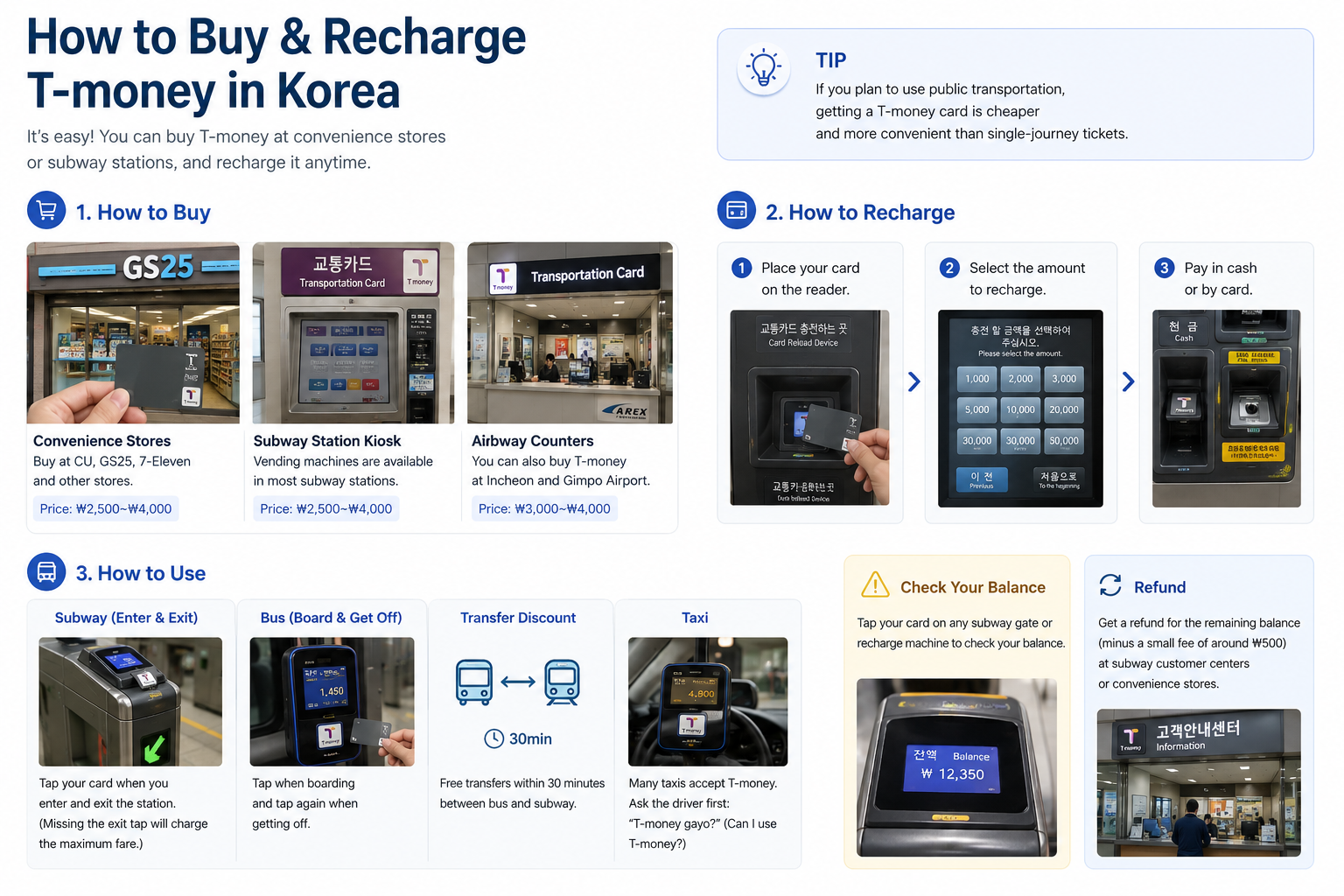
Current VisitKorea guidance lists T-money cards at convenience stores such as GS25, CU and 7-ELEVEN nationwide, as well as information centers at Seoul subway stations on Lines 1 through 8. General card prices are currently listed at about ₩3,000 to ₩5,000, although the price can vary with the card design and seller.
For most visitors, there is little reason to turn this into a pre-trip purchase. Buying after arrival is normally straightforward. Look for the T-money logo at a convenience store or station rather than searching for a special tourist version of the card.
The card price and the money stored on the card are separate. If you buy the card and walk straight to a subway gate without adding value, the card itself does not give you a ride.
How Much Should You Load?
There is rarely a good reason to load a large amount on day one.
For a short Seoul trip, Korea Inside would usually start with around ₩20,000 to ₩30,000 and add more later. That is planning advice, not an official T-money rule. Your actual spending depends on how often you ride, how far you travel and whether you also use the balance at participating merchants.
Starting smaller also makes the end of the trip easier. A card with a few thousand won left is much less annoying than one with a large balance you suddenly have to refund before the airport.
Recharging a Physical Card
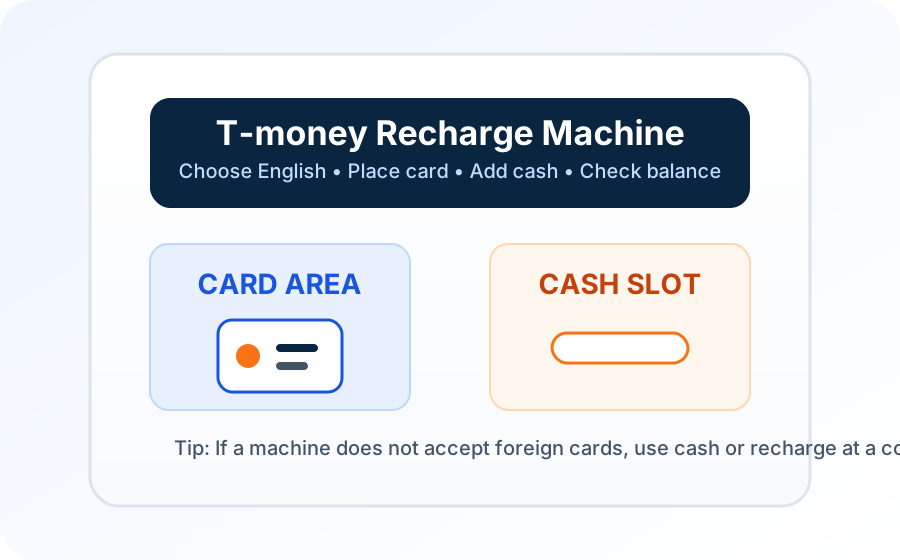
For an ordinary physical T-money card, cash is still the safest assumption for a foreign visitor. Subway recharge machines are straightforward once you know where the cash slot is, and participating convenience stores can also add value to the card.
Do not confuse this with Seoul's newer international-card ticket machines. In 2026, Seoul expanded overseas credit and debit card payments at new subway kiosks for products such as Climate Card short-term passes and single-journey tickets. That does not mean every ordinary T-money recharge machine now accepts an overseas card.
If a machine rejects your card, that is not a reason to keep trying the same payment method. Use Korean won or take the T-money card to a participating convenience store.
The balance shown at a subway gate or recharge machine is useful enough for most visitors. Add money when the balance starts getting low rather than trying to calculate the entire trip in advance.
Using T-money on the Subway and Bus
The subway routine is simple after the first ride: tap once when you enter and tap again when you leave. The exit tap closes that journey and lets the system calculate the fare.
Buses need the same habit. Tap when you board and tap again before getting off.
That second bus tap is easy to forget because the door is already open and everyone is moving. It matters because transfer discounts depend on the transport system knowing where one ride ended and the next one began.
When you transfer correctly between eligible buses and subways, T-money can apply the relevant transfer discount automatically. The detailed transfer window varies by system and time, so this guide does not need to turn a simple habit into a timetable: tap properly every time.
Where T-money Works Beyond the Subway
Subways and city buses are the reason most travelers buy T-money, but the network is wider than Seoul.
T-money's current official usage guide lists subway and bus coverage across many regions of Korea, including the major metropolitan systems. It also lists taxi acceptance across a large number of cities and counties.
Taxi payment is not completely uniform. T-money itself warns that restrictions can apply in some areas, so seeing a card reader or the T-money mark is more useful than assuming every taxi will accept the balance.
T-money can also be used at participating retail and other partner locations that display the relevant T-money acceptance mark. That is useful for an occasional convenience-store purchase, but it is better to think of T-money as a transport card with some extra payment uses rather than as a replacement for a normal debit or credit card.
Some express buses, intercity transport, rail counters and toll-road situations also support particular T-money products or card types, but the rules are more specific. For ordinary travel planning, buses and subways are the dependable core.
Apple Wallet T-money: Convenient, With One Important Catch
Apple and T-money launched T-money in Apple Wallet on July 21, 2025. A supported iPhone or Apple Watch can now act as a prepaid T-money transit card, so the old advice that iPhone users simply cannot use T-money on their phone is no longer correct.
Apple currently lists support for iPhone Xs and Xr or later with iOS 17.2 or later, and Apple Watch Series 6 or Apple Watch SE 2nd generation or later with watchOS 10.2 or later. Only prepaid T-money is supported in Apple Wallet.
With Express Mode enabled, you can tap the device at a transit reader without opening Wallet for every ride. The balance is also visible in Wallet.
The part that matters most to an overseas visitor is funding. Apple's current support guidance says a South Korea-issued credit or debit card is required to purchase or top up a T-money card from Apple Wallet.
International users now have a separate route through MobileTmoney. The current App Store listing says the app is available without sign-up for basic use and supports Apple Pay top-up with Mastercard, American Express, UnionPay and JCB. Visa is not currently listed for this international-user top-up route.
So an iPhone is not, by itself, a reason to skip the physical card. If your Apple Pay card network is not supported by MobileTmoney, keep a physical T-money card or another confirmed funding route as backup.
One T-money card can be used on one Apple device at a time. If you want separate transit cards on an iPhone and an Apple Watch, Apple says each device needs its own card.
Android Travelers Have a Different Mobile Route
T-money also operates the KOREA TOUR CARD Tmoney app for compatible Android phones.
The current official Google Play listing says the app can use NFC as T-money, show the balance and transaction history, and handle top-up or refund using supported international cards including Mastercard, Visa, American Express, JCB and UnionPay.
Seoul has also pointed to the KOREA TOUR CARD app as an overseas-card recharge route for Android travelers.
The word compatible matters. NFC hardware, phone configuration and app support can vary, so install and check the app before treating your phone as the only transport card you will carry in Korea.
Children and Teenagers
A child or teenager should not simply use an adult T-money card and expect the discounted fare to appear automatically.
Current VisitKorea guidance says travelers under 18 need to register their date of birth to receive the relevant public-transport discount. A convenience store that handles T-money is the practical place to ask about the registration when buying the card.
If you are traveling as a family, do this near the beginning of the trip rather than discovering after several rides that the card has been charging the adult fare.
When the Balance Is Too Low
Running short of balance is usually an inconvenience, not a disaster.
Recharge machines and many subway gates show the remaining amount. Seoul's official subway guidance also notes that fare-adjustment machines near ticket gates can be used when a T-money balance is insufficient.
If you notice the balance is getting low before a longer journey, topping up outside the gate is easier than dealing with it while people are waiting behind you.
Refunds Before You Leave Korea
T-money balance refunds are possible, but this is one part of the system where old travel pages can be misleading.
As of this August 2026 review, VisitKorea says T-money balances over ₩50,000 must be refunded at Tmoney Town near Seoul Station, while smaller balances can be handled at convenience stores. Some older official Seoul tourism pages still show a lower convenience-store threshold.
For that reason, Korea Inside does not recommend planning a large final refund around an old number from a blog or screenshot. Check the current T-money or VisitKorea guidance if a substantial balance remains.
The easier strategy is to stop adding large amounts near the end of the trip. Keep enough for your remaining buses, subways and airport journey, then spend the balance down naturally.
A balance refund and the original price paid for the physical card are not the same thing. Do not assume returning the card means recovering every won you originally spent.
The Problems Travelers Usually Run Into
“I bought the card, but the subway gate says there is no balance.”
Buying the physical card and loading travel money are separate steps. Take it to a recharge machine or participating convenience store and add Korean won before trying the gate again.
“The recharge machine will not take my overseas card.”
For a normal physical T-money card, cash remains the safest default. Seoul's newer international-card kiosks should not be treated as proof that every ordinary T-money machine accepts a foreign card.
“I forgot to tap when I got off the bus.”
The exit tap matters for transfers. Make the second tap part of the routine even when you are not immediately changing to another bus or subway.
“My T-money worked on the subway but not in a taxi.”
Taxi acceptance is broad but not universal. T-money's own usage guide notes that regional restrictions can apply. Use another payment method if the vehicle cannot process the card.
“I have an iPhone, so I thought I would not need a physical card.”
Apple Wallet now supports T-money, but direct Wallet funding still requires a South Korea-issued credit or debit card. International users may instead use MobileTmoney with a currently supported Apple Pay card network; Visa is not currently listed.
“I loaded much more than I need.”
You can look into a balance refund, but refund locations and amount limits are more complicated than using the card. Toward the end of the trip, smaller top-ups are usually easier.
“I am not sure whether a shop accepts T-money.”
Look for the T-money acceptance mark or ask before paying. Retail use is a useful extra, but it is not the reason to depend on T-money as your only payment method.
T-money or WOWPASS?
If transportation is the main problem you are trying to solve, T-money is still the simpler product.
WOWPASS becomes more relevant when you also want a Korean prepaid payment balance, foreign-currency funding and card-management features. Its T-money transport function is built into the same physical card, but the WOWPASS payment balance and T-money balance remain separate.
T-money vs WOWPASS guide
If you already know you want WOWPASS, the WOWPASS guide explains how its two balances work in practice.
WOWPASS guide
T-money FAQ
What is T-money?
T-money is a prepaid transportation card used across much of Korea's public transport network. It is widely used on subways and buses and can also work in many taxis and participating retail locations.
Where can I buy a physical T-money card?
Current VisitKorea guidance lists convenience stores such as GS25, CU and 7-ELEVEN nationwide, as well as information centers at Seoul subway stations on Lines 1 through 8. Look for the T-money logo because stock and card designs can vary by location.
How much does a T-money card cost?
VisitKorea currently lists general physical T-money cards at about ₩3,000 to ₩5,000. Special designs or products can cost differently, and the card price is separate from the balance you add for travel.
How do I recharge a physical T-money card?
Cash at a subway recharge machine or a participating convenience store is the most predictable method for an international visitor. Do not assume every machine accepts an overseas credit or debit card.
Can I recharge a normal T-money card with a foreign credit card?
Do not rely on it as the default. Seoul has introduced international-card support at newer subway kiosks for products including Climate Card short-term passes and single-journey tickets, but that should not be treated as universal overseas-card support for ordinary physical T-money recharging.
Can I use T-money in Apple Wallet?
Yes. Apple Wallet has supported prepaid T-money since July 21, 2025 on supported iPhone and Apple Watch models. Direct purchase or top-up in Apple Wallet currently requires a South Korea-issued credit or debit card. International users also have a separate MobileTmoney route that supports Apple Pay top-up with Mastercard, American Express, UnionPay and JCB; Visa is not currently listed for that route.
Can I use my Android phone as T-money?
T-money's KOREA TOUR CARD Tmoney app provides a mobile T-money option for compatible NFC Android phones and currently advertises top-up and refund with several international card networks. Device compatibility should be checked before relying on it.
Do I tap T-money when getting off?
Yes. Tap when entering and leaving a subway journey. On buses, tap when boarding and again before getting off. The bus exit tap matters for transfer discounts.
Can I use T-money in taxis and convenience stores?
Many taxis and participating retail locations accept T-money, but acceptance is not universal. Check the T-money mark or payment terminal, especially for taxis outside the major cities.
How much should I load first?
There is no single amount that fits every trip. Korea Inside would usually start with around ₩20,000 to ₩30,000 for a short Seoul stay and add more later rather than loading a large balance immediately.
Can I refund my remaining T-money balance?
Yes, subject to the current refund rules and outlet limits. As of August 2026, VisitKorea says balances above ₩50,000 are handled at Tmoney Town near Seoul Station while smaller balances can be refunded at convenience stores. Check the latest guidance before relying on a specific refund location.
Should I use T-money or WOWPASS?
If you mainly need buses and subways, T-money is usually simpler. WOWPASS is more useful when you also want prepaid shopping payments, supported foreign-currency funding and app-based card management. See the Korea Inside T-money vs WOWPASS guide for the full comparison.
Official Sources
Full page reviewed: August 2026. MobileTmoney international-user route rechecked: October 7, 2026.
T-money payment methods, refund outlets, device support and transit acceptance can change. When a specific payment card, phone or refund location matters to your trip, use the current T-money, Apple or official tourism guidance rather than an old screenshot.