
Insadong Travel Guide 2026
Insadong is easy to plan badly in two opposite ways.
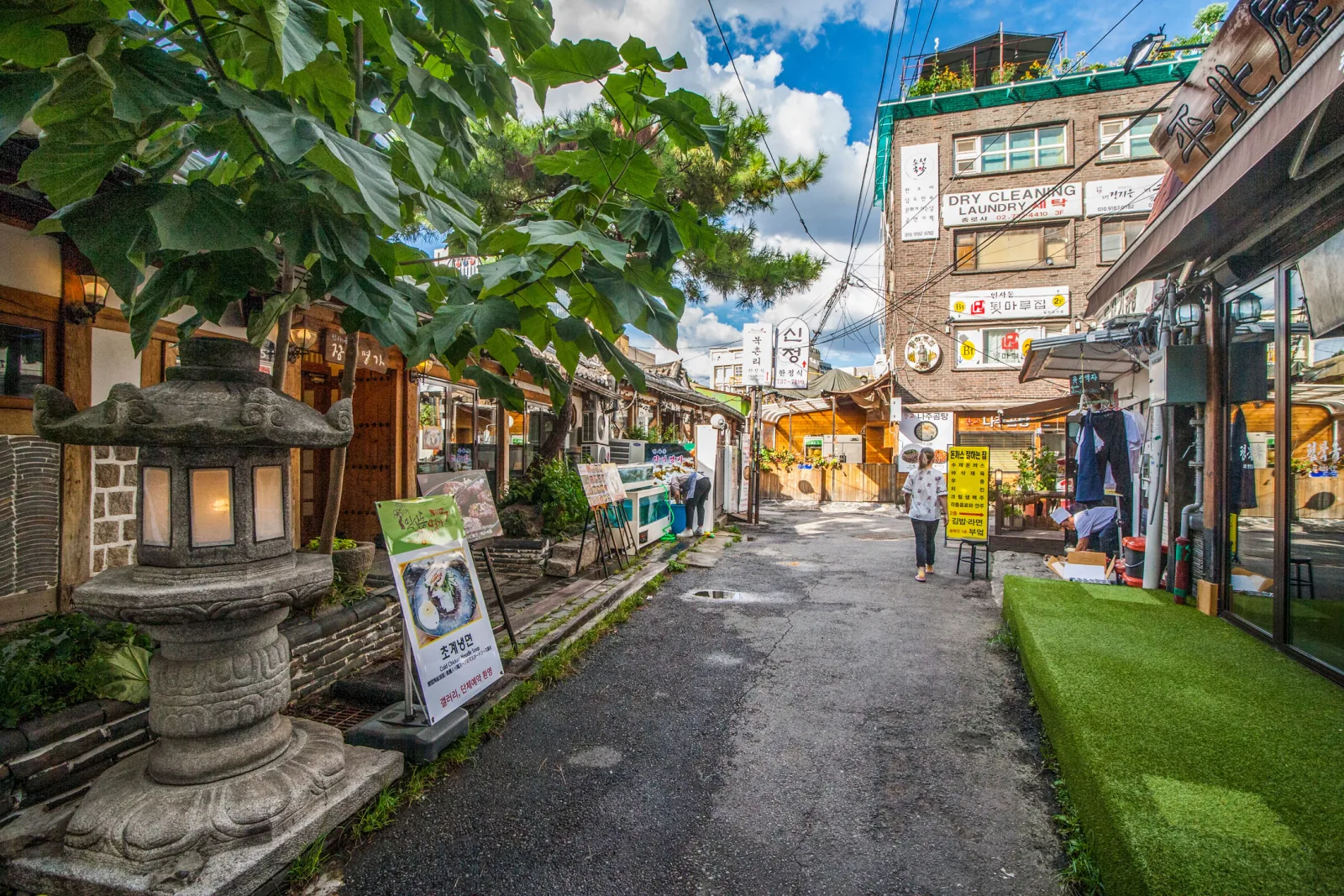
You can walk straight down the main street, look at a few souvenir shops and wonder why the neighborhood is famous.
Or you can save twenty craft shops, five tea houses, Ssamzie-gil, Jogyesa and several nearby neighborhoods and turn a relaxed part of Seoul into another checklist.
For most travelers, Insadong does not need a full sightseeing day by itself.
Give the neighborhood a few hours for Korean crafts, a proper meal, one traditional tea stop and the streets that catch your attention.
If this is your first trip to Seoul, Insadong becomes stronger when it sits inside a larger historic route:
Gyeongbokgung → Bukchon → Insadong → Jogyesa → one evening choice
That last choice might be Ikseon-dong, Cheonggyecheon or simply dinner around Jongno.
The point is not to complete Insadong.
It is to slow down enough to notice why this part of central Seoul still feels different from another shopping district.
What Insadong Is Actually Good For
Insadong works best when you want the middle of the day to slow down.
You may have spent the morning inside Gyeongbokgung or walking through Bukchon's hills and hanok streets.
By the time you reach Insadong, you do not necessarily need another large attraction.
You need somewhere to eat, browse, sit down, buy something worth carrying home and decide how much more of central Seoul you still want.
That is the role Insadong plays particularly well.
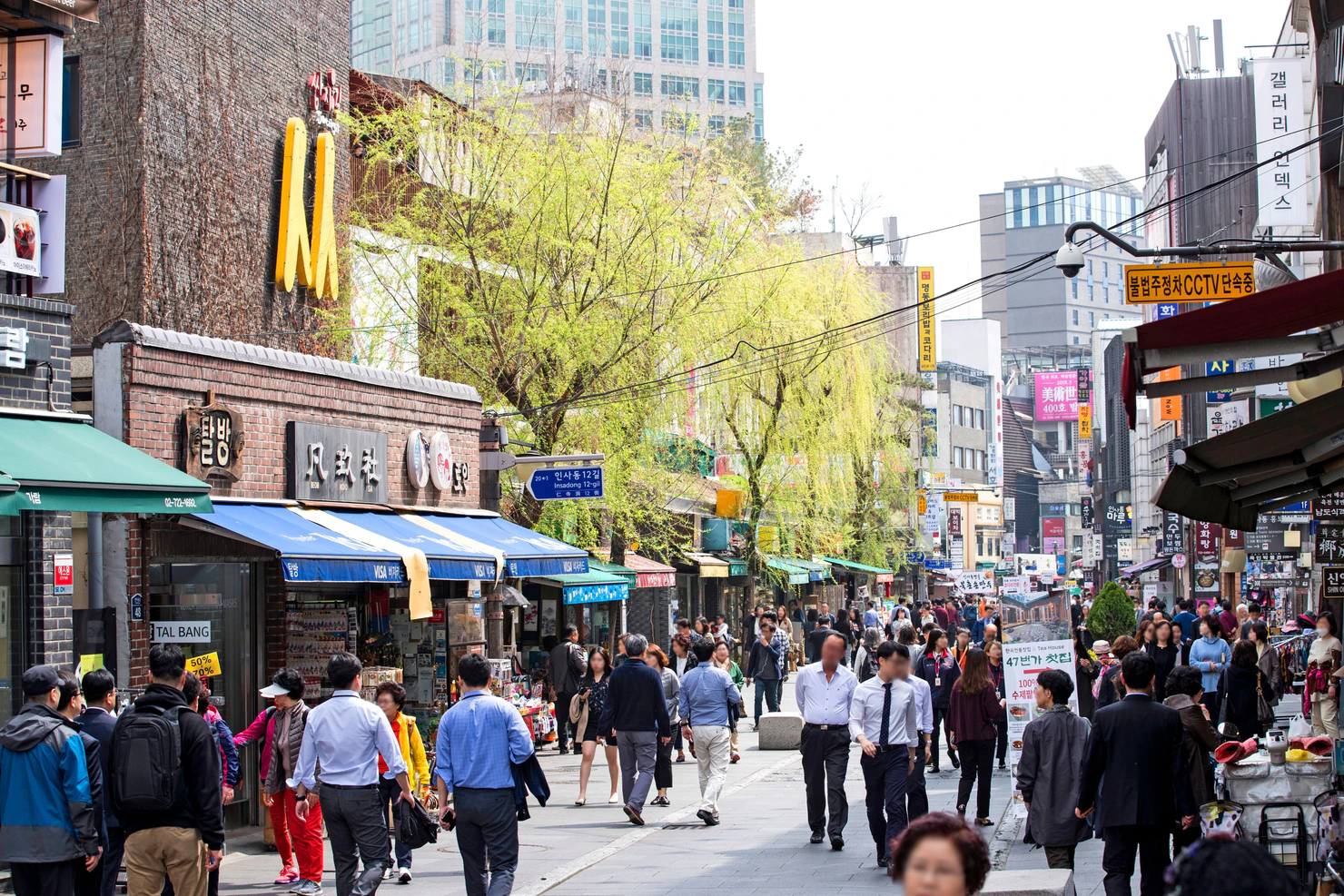
Come here for Korean crafts, not just generic souvenirs
The main street has plenty of easy tourist shopping.
That is not the whole reason to visit.
Look beyond the first souvenir displays and you begin to find ceramics, paper goods, calligraphy materials, small craft objects, galleries and shops where the product itself has more connection to Korean design and traditional materials.
You do not need to become an expert on Korean crafts.
You only need to distinguish between two different purchases:
something inexpensive that reminds you of Korea,
and something you chose because the object itself interested you.
Both are valid.
They are not the same shopping experience.
Traditional tea deserves more time than another quick coffee
Insadong is one of the places where sitting down is part of the visit.
A traditional tea stop should not be squeezed into fifteen minutes between shops.
Choose one place.
Order something you actually want to try.
Then stay seated long enough for the stop to do its job.
For a traveler who has already walked through a palace and Bukchon, 40 or 50 minutes off your feet can improve the rest of the day more than another attraction.
If tea does not interest you, skip it.
You do not need to perform traditional culture because you are in Insadong.
The side alleys matter more than completing the main street
Insadong-gil gives you an easy line through the neighborhood.
Use it that way.
But some of the better meals, tea houses, galleries and smaller shops sit away from the obvious pedestrian flow.
Look into the side streets when something gives you a reason to turn.
Do not enter every alley because a guide told you there might be something hidden there.
The main street should keep you oriented.
The side streets are where you make the visit your own.
Ssamzie-gil is a good reference point, not a half-day attraction
Ssamzie-gil is worth seeing on a first visit.
Its shops and spiral layout make it easy to browse a range of crafts and design goods without crossing the neighborhood repeatedly.
For many travelers, one pass through the building is enough.
Stay longer if the shops interest you.
Leave sooner if they do not.
You have not failed to understand Insadong because you did not photograph every level.
Jogyesa fits because it changes the pace again
Jogyesa is close enough to add without reorganizing the day.
More importantly, it gives you something different from shops and tea houses.
It is an active Buddhist temple.
People are there to pray, attend ceremonies and go about religious life.
A short visit can be enough when Buddhism is not one of your main interests.
Keep your voice down, look around and remember that the people in front of you are not part of a tourist display.
Insadong is strongest in the daytime
This is not where I would build a Seoul night around clubs, late-night shopping or bar-hopping.
Insadong earns its time earlier:
lunch, crafts, tea, galleries, a temple and walking.
When the day starts turning into evening, another neighborhood may make more sense.
Ikseon-dong works when you want cafés, restaurants and a busier hanok setting.
Jongno can continue into dinner and drinks.
Cheonggyecheon works when you have had enough shops and want to keep walking.
Insadong does not need to solve every part of the day.
Who may not need much time here
If you have little interest in crafts, traditional tea, galleries or historic central Seoul, do not give Insadong half a day simply because it appears on first-time itineraries.
Walk through for an hour or two if it fits between other places.
Then move on.
Travelers whose priorities are contemporary fashion, K-beauty flagships or nightlife will usually find stronger reasons to spend their time elsewhere.
Insadong becomes valuable when its slower parts are things you actually want.
That is the difference between visiting a famous street and having a reason to stay.
Start With the Time You Actually Have
Insadong becomes easier once you stop treating it as a neighborhood you need to complete.
How much time it deserves depends on whether Insadong itself is the destination or one part of a larger historic-Seoul day.
If you have about two hours
Keep the visit simple.
A practical version is:
Insadong-gil → Ssamzie-gil → traditional tea
or:
Insadong-gil → lunch → Jogyesa
Two hours is enough to understand the main street, browse one concentrated craft space and do one thing that makes Insadong different from an ordinary shopping district.
It is not enough for a long lunch, serious craft shopping, several galleries, traditional tea and Jogyesa without rushing.
Choose what matters.
If you have four to five hours
This is the range I would use when Insadong itself is one of the main parts of the day.
You have enough time for:
Insadong-gil → Ssamzie-gil → proper lunch → selected crafts or galleries → traditional tea → Jogyesa
The important part is that you can stop.
You can sit through lunch instead of eating quickly because another attraction is waiting.
You can spend 40 minutes over tea.
You can enter a ceramic shop or gallery because it actually interests you rather than because the itinerary says you have seven minutes available.
For many travelers, this is enough Insadong.
If you have a full sightseeing day
Do not simply make Insadong longer.
Use the extra time to connect it to the historic neighborhoods around it.
For a first Seoul trip, a stronger day is:
Gyeongbokgung → Bukchon → Insadong → Jogyesa → one evening choice
Insadong becomes the middle of the day rather than the entire day.
That gives each area a different job.
The palace gives you the formal history.
Bukchon gives you residential hanok streets.
Insadong gives you lunch, crafts, tea and a slower commercial break.
Jogyesa changes the pace again.
Then the evening can move somewhere else.
If you already visited the palaces and Bukchon
Do not repeat them just to create a longer itinerary.
Start directly in Insadong.
Give the neighborhood four or five hours, then continue toward Ikseon-dong, Cheonggyecheon or another part of Jongno.
A second Seoul visit should not have to reproduce a first-trip checklist.
More time should mean more choice, not more stops
This is the rule I would keep.
If you have an extra hour, spend longer in the gallery that interested you.
Sit longer over tea.
Buy the ceramic piece you actually want after thinking about it.
Have a slower lunch.
Do not automatically add another attraction because the schedule has space.
Insadong is one of the parts of Seoul where leaving some time unclaimed usually improves the visit.
Where to Start: Anguk or the Southern Side?
There is no single correct entrance to Insadong.
Anguk Station is the easiest default for many first-time visitors, but the better starting point depends on where the rest of your day already places you.
Start at Anguk when you are coming from the palace side
Anguk works naturally when you are arriving from:
Gyeongbokgung
Bukchon
Samcheong-dong
another Line 3 route
It also puts you close to the northern end of Insadong.
From here, a simple route is:
Anguk → Insadong-gil → Ssamzie-gil → lunch / tea → Jogyesa → southern Jongno
That gives the neighborhood a direction.
You keep moving instead of reaching the middle of Insadong and repeatedly turning back toward places you already passed.
Start from the southern side when your day is already in Jongno
If you are coming from Jonggak, Jongno, Cheonggyecheon or another area south of Insadong, do not ride past the neighborhood just to begin at a station called Anguk.
Enter from the side you are already on.
Then work north through Insadong and finish near Anguk if that direction helps the next part of the day.
The street works both ways.
Your itinerary should decide the direction, not the name of the subway station.
Jongno 3-ga can also make sense
Jongno 3-ga is useful when Ikseon-dong is already part of the day or when Lines 1, 3 or 5 fit your route better.
But remember that a multi-line station can involve more walking inside the station than the street map suggests.
A short distance from an exit does not always mean a short trip from the platform.
If Anguk gives you a simpler arrival, use Anguk.
If Jongno 3-ga removes a transfer and fits the rest of the day, use Jongno 3-ga.
Think about where you want to finish
This is often more useful than asking where you should start.
If the evening plan is Ikseon-dong or Jongno, starting around Anguk and moving south usually makes sense.
If you came from Cheonggyecheon and want to continue toward Bukchon or Samcheong-dong afterward, reverse the route.
Insadong is compact enough that either direction works.
What wastes time is crossing the same part of the neighborhood repeatedly because the itinerary has no direction.
The Korea Inside default
For a first visit:
Anguk → Insadong-gil → Ssamzie-gil → lunch → crafts / galleries → traditional tea → Jogyesa
is the easiest default.
Not because Anguk is the only correct entrance.
Because it creates a simple one-way route through the neighborhood and leaves several good options for what comes next.
Insadong-gil: Use the Main Street as a Spine
Insadong-gil is useful because it keeps the neighborhood easy to understand.
It should not become the entire visit.
Walk the main street in one direction and use it as the route that brings you back after entering smaller alleys, shops and galleries.
That is more useful than repeatedly walking the same section because every saved place sits on a different side street.
Look sideways
Some travelers walk from one end of Insadong-gil to the other, pass souvenir shops for 20 minutes and leave wondering what they were supposed to see.
The better approach is to keep looking off the main street.
A small gallery, ceramic shop, tea house or restaurant can be a better reason to turn than another shop directly in front of you.
But do not enter every alley just because a guide tells you the interesting places are hidden.
Turn when something actually gives you a reason.
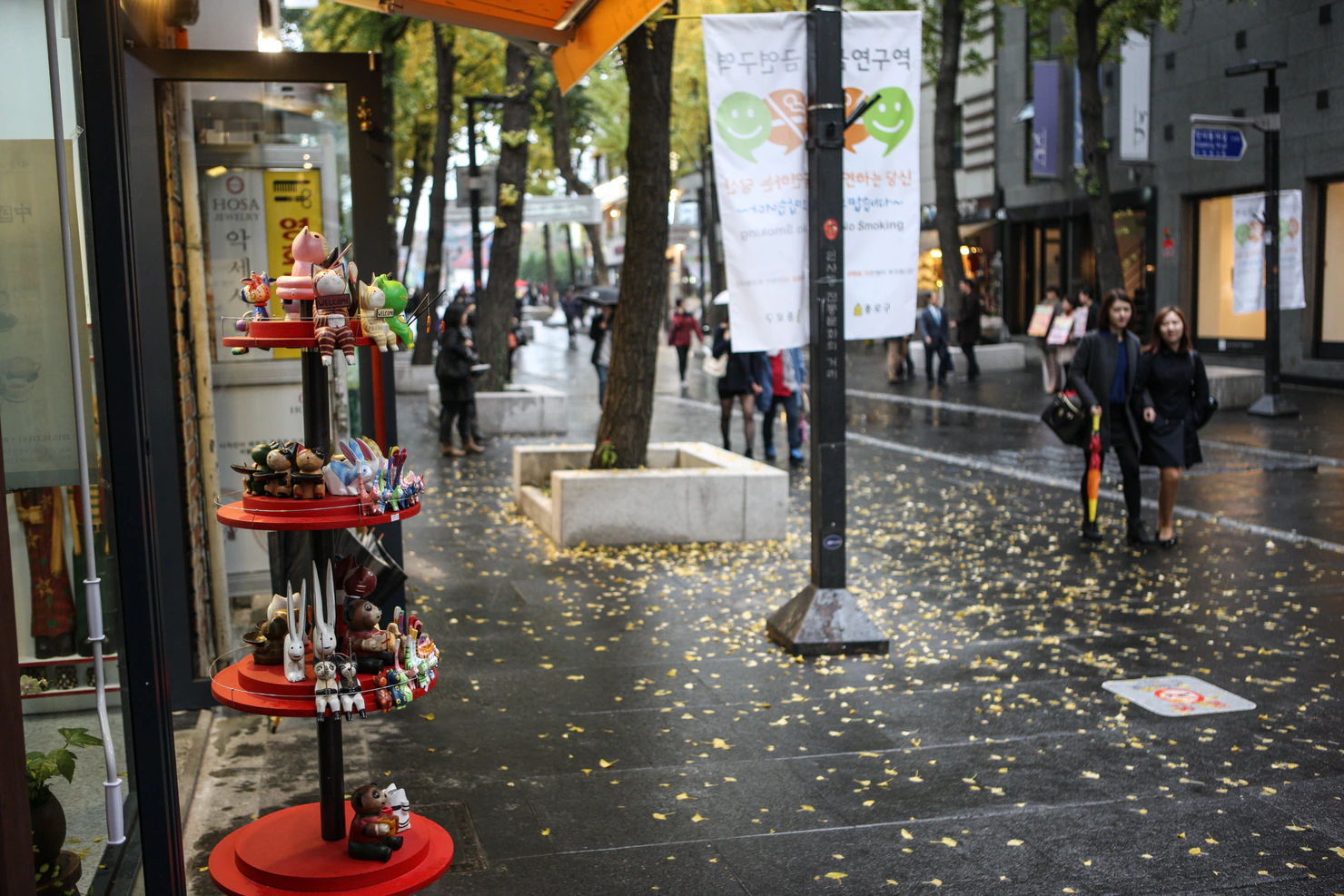
You do not need to enter every shop
Insadong creates the same problem as Myeongdong and Seongsu in a different form.
There are enough shops that browsing can quietly consume the afternoon.
The difference is what you are browsing.
Instead of cosmetics or fashion, the decision may be ceramics, paper goods, calligraphy materials, paintings, crafts or gifts.
Pick the categories that interest you.
Walk past the rest.
A shop being traditional-looking does not automatically make it relevant to your trip.
Give galleries permission to be short stops
You do not need to understand contemporary Korean art before entering a small gallery.
If the exhibition catches your attention, go in.
If it does not, continue walking.
The mistake is turning galleries into another checklist where you feel obliged to spend the same amount of time in every space.
Five interesting minutes is still a valid stop.
Do not backtrack for a weak saved pin
A recommendation you saved months ago can look important on your phone and ordinary when you arrive.
That is fine.
If you have already walked past it and nothing about it still interests you, keep moving.
Insadong works better when the route responds to what you find in front of you.
The main street gives you enough structure that you can afford to be flexible.
Crafts & Souvenirs: Decide What You Are Buying First
Insadong is one of the easiest places in central Seoul to buy a souvenir.
That does not mean every traditional-looking object deserves space in your suitcase.
Before you shop, decide what kind of purchase you are making.
If you just want a small reminder of Korea
Keep it simple.
A bookmark, stationery item, small decorative object or other light gift may solve the problem better than a fragile item you have to protect for the rest of the trip.
You do not need an heirloom every time you buy a souvenir.
Cheap and convenient can be the correct choice when that is what you actually want.
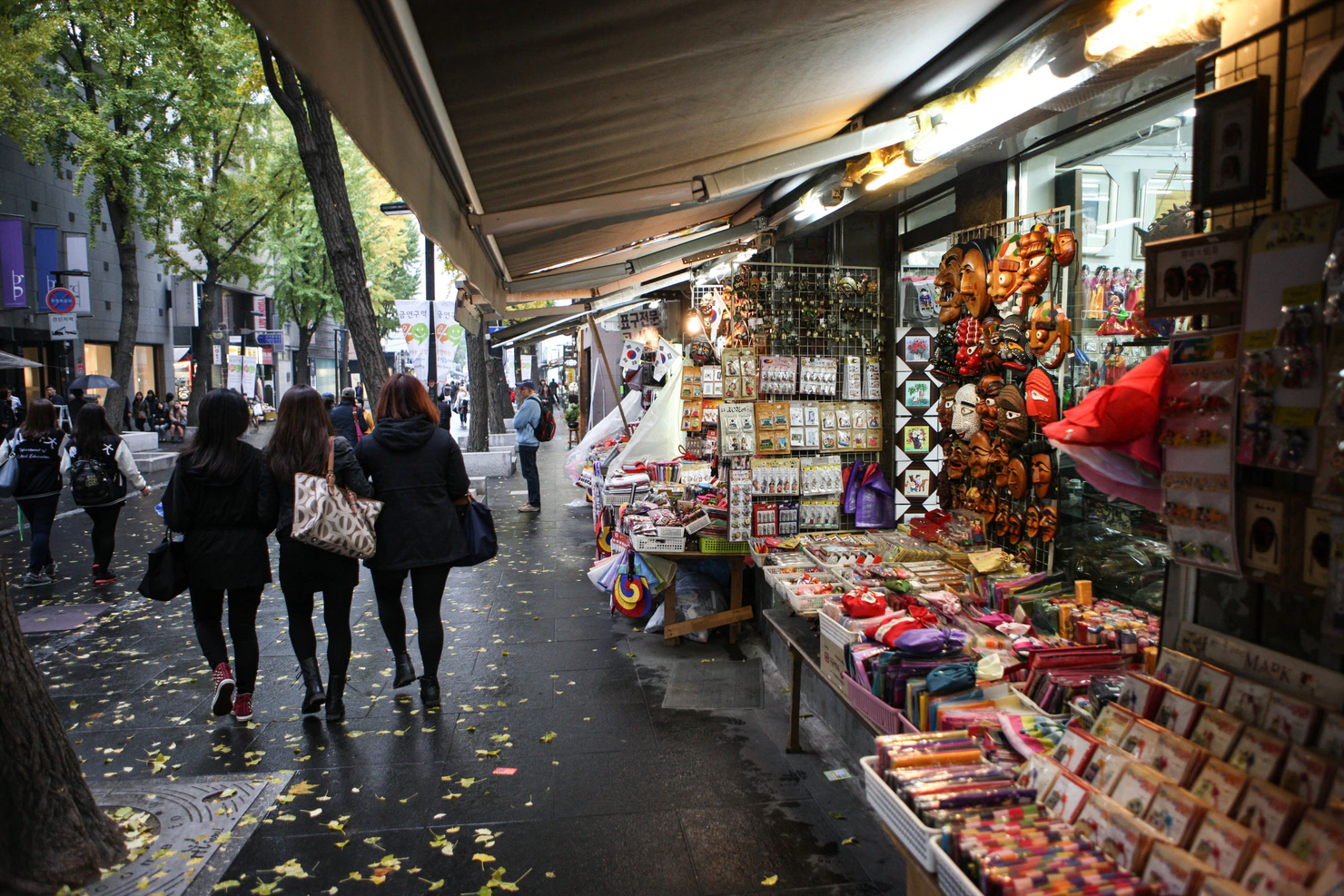
If Korean paper or stationery interests you
Give that category real time.
Hanji, calligraphy-related goods and Korean stationery offer something different from a generic souvenir shelf.
Look at the paper, printing, material and design rather than buying the first item with traditional imagery on it.
This is the kind of shopping where a small specialized store may be more interesting than a larger general gift shop.
If you want ceramics or a real craft object
Slow down before buying.
A cup, bowl, decorative ceramic or handmade craft takes more luggage space and is harder to replace if it breaks.
Ask yourself whether you like the object itself enough to carry it through the rest of Korea and the flight home.
Also look at what the shop actually tells you about the piece.
Do not assume that every object with a traditional design is handmade, locally produced or made by a particular artist.
If that distinction matters to you, ask before paying.
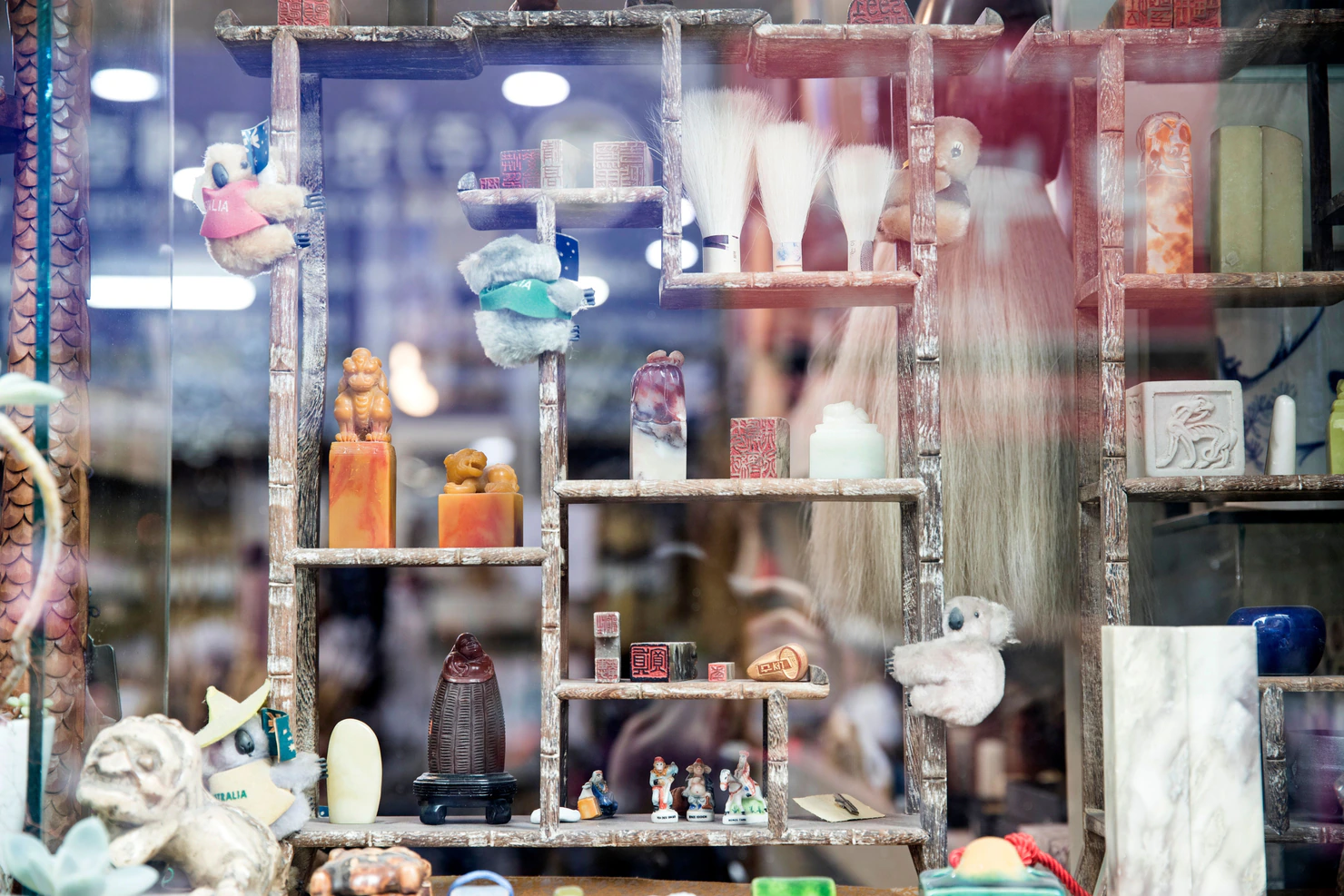
If you want something personal
A customized object can make more sense than another generic gift.
That might mean a name stamp, calligraphy, a handmade object or something produced through a craft experience.
But personalization takes time.
If it is one of the reasons you came to Insadong, give it a real place in the itinerary.
If not, do not let an unplanned workshop consume the tea, lunch or neighborhood walk you cared about more.
Price should follow the reason you are buying
Do not compare a simple tourist gift and a handmade craft as though they are competing products.
They solve different problems.
One is an inexpensive reminder.
The other may be something you are buying because of the material, technique, artist or design.
Decide which one you want first.
Then compare within that category.
Think about the suitcase before the checkout counter
This is especially important with ceramics, framed art and larger decorative items.
The object still has to survive the rest of the trip.
If you are changing hotels several times or flying with limited baggage, a smaller piece can be the better purchase even when you like the larger one more.
Ask about protective packaging before paying.
A beautiful object becomes a bad travel purchase if you spend the next five days worrying about breaking it.
The Korea Inside rule
Buy the cheap souvenir when a cheap souvenir is what you want.
Spend more when the object itself gives you a reason.
And if nothing interests you enough to carry it home, buy nothing.
Insadong is still worth visiting without a shopping bag.
Ssamzie-gil: See It, but Do Not Build the Day Around It
Ssamzie-gil is one of the easiest landmarks to use when you are visiting Insadong for the first time.
Its spiral walkway takes you gradually from street level to the rooftop, with small shops, galleries and craft spaces along the way.
That makes it useful.
You can see several kinds of Korean craft and design products without walking back and forth across the neighborhood.
It does not mean you need to spend half the afternoon here.
About 30 to 40 minutes is enough for many travelers
Walk the building once from bottom to top.
Look into the shops that actually interest you.
Stop for longer if you find ceramics, stationery, jewelry, artwork or another craft you genuinely want to examine.
If nothing catches your attention, reach the top, look around and continue the neighborhood.
Ssamzie-gil should help you understand Insadong.
It should not become an obligation to inspect every shop.
The building itself is part of the reason to go
Ssamzie-gil was designed so its continuous path works almost like another Insadong alley, winding upward around the central courtyard.
That is more interesting than treating it as a normal indoor shopping center.
The shops matter, but so does the way the building turns browsing into one continuous walk.
Notice that once.
Then decide whether the products deserve more of your time.
Do not confuse concentration with uniqueness
One advantage of Ssamzie-gil is convenience.
Many small shops are concentrated in one place.
That does not mean everything worth buying in Insadong is inside the building.
If you find something you like, buy it.
If you are still unsure, keep walking through the neighborhood before deciding.
For a purchase you will carry home, another 30 minutes of comparison is often more useful than buying the first object you see.
Skip quickly when this is not your kind of shopping
Travelers who are not interested in crafts, design goods or souvenir shopping do not need to manufacture enthusiasm for Ssamzie-gil.
Walk through once.
Then use the time for lunch, tea, Jogyesa or another part of central Seoul.
A famous stop can still be a short stop.
Traditional Tea: Choose One Place and Actually Sit Down
Traditional tea is one of the few parts of an Insadong visit that should become slower rather than more efficient.
Do not treat it like another shop.
The point is not to order, photograph the cup and leave ten minutes later.
Choose one tea house and give yourself time to sit.
Forty to sixty minutes is reasonable
By the time you stop for tea, you may already have spent several hours walking through a palace, Bukchon or Insadong itself.
That changes the value of the stop.
You are not only trying a Korean drink.
You are resting your feet, getting out of the pedestrian flow and giving the second half of the day a better chance.
For many travelers, that is worth more than squeezing in one additional gallery or souvenir shop.
You do not need to understand Korean tea before entering
A traditional tea menu can be unfamiliar.
That is fine.
Read the English explanation when one is available and ask what the house is known for if you are uncertain.
Some travelers will want tea based on tea leaves.
Others may prefer fruit, grain or herbal-style traditional drinks.
You do not need to choose the most culturally impressive item on the menu.
Choose something you actually want to drink.
The tea house matters differently from the drink
Part of the appeal can be the room itself.
Insadong still has traditional tea shops where the atmosphere, tea service and slower pace are central to the experience.
That does not mean one famous tea house is the only correct choice.
Choose the place whose atmosphere and menu fit the kind of break you want.
Do not turn tea houses into café hopping
One is enough for the default itinerary.
A second tea house usually does not add as much to the day as the first one did.
If traditional tea is a major personal interest, ignore this rule and explore more deeply.
For everyone else:
one tea house → sit down properly → continue
is the stronger use of Insadong.
Tea and lunch should not compete for the same job
If you are hungry, eat first.
Traditional tea and a small dessert are not automatically lunch.
Likewise, if you just finished a large Korean meal, you do not have to enter a tea house immediately because the itinerary says it comes next.
Walk for a while.
Use the tea stop when you actually want the break.
The schedule should follow your body as well as the map.
The Korea Inside default
For a first visit:
crafts and walking first → lunch → another short browse → one traditional tea house
creates a better rhythm than:
shop → café → shop → café → shop.
Insadong becomes more useful when the quiet parts of the neighborhood are allowed to stay quiet.
Eat a Real Meal in Insadong
An Insadong day can easily become:
snack → tea → dessert → another snack
and then everyone realizes at 4 p.m. that nobody actually ate lunch.
Do not let that happen unless grazing was the plan from the beginning.
If you came from Gyeongbokgung or Bukchon, Insadong is a good place to stop walking for an hour and have a proper meal.
Let lunch do one job
Lunch should solve hunger.
Traditional tea can solve the slower cultural break later.
You do not need to combine both into one hurried stop just because they appear close together on the map.
Sit down.
Eat properly.
Then return to the street.
That hour usually gives you more usable afternoon than protecting another saved shop.
Dumplings or soup make sense when you want something straightforward
You do not need a large Korean set meal every time you eat in Insadong.
A bowl of soup, sujebi or mandu can be a better choice when you still have several hours of walking ahead.
The reason to mention this category is not that every traveler must eat at one famous restaurant.
It shows that an Insadong lunch can be simple, warm and recognizably Korean without becoming a long formal dining experience.
If the queue is unreasonable, eat somewhere else.
Lunch should not cost an hour of standing unless the restaurant itself is one of your priorities.
A Korean set meal is a different decision
If you want lunch itself to become part of the cultural experience, a hanjeongsik-style meal can justify more time.
That makes more sense when:
you are traveling with parents or a group
everyone wants to sit for a while
the meal itself is part of what you came to experience
you are not trying to reach another timed attraction immediately afterward
It makes less sense when you only have two hours in Insadong.
A longer meal should replace something else.
It should not simply be added on top of the itinerary.
Vegetarian travelers have a stronger option here than they may expect
Temple cuisine gives Insadong and the Jogyesa area a food option that is genuinely different from another tourist district.
This is not interchangeable with a quick bowl of noodles.
If temple food itself interests you, give the meal enough time and check the current hours and reservation conditions before going.
If you only need lunch, you do not have to turn it into a cultural program.
Check the break before walking across Insadong for one restaurant
This matters in Korea.
A restaurant can be open for lunch and dinner but close for several hours in between.
So if one specific restaurant matters:
check today's hours first.
Do not walk across the neighborhood at 3:30 p.m. because an old map listing only said “open until 9.”
The Korea Inside default
If you came from a palace or Bukchon:
walk first → proper lunch → crafts and shopping → traditional tea later
is the better rhythm.
Tea is the pause.
Lunch is the meal.
Let each one do its own job.
Jogyesa: Add It Because It Fits the Route
Jogyesa does not need to become another major sightseeing project.
That is part of why it fits Insadong so well.
You can leave the shops and tea houses, walk a short distance and suddenly enter an active Buddhist temple in the middle of central Jongno.
The change of atmosphere is the reason to include it.
About 20 to 30 minutes is enough for many travelers
Walk through the grounds.
Look at the main temple buildings.
Slow down for a few minutes.
Then continue your day.
If Buddhism, temple architecture or a ceremony genuinely interests you, stay longer.
If not, a short visit is enough.
Do not stretch the stop simply because a famous place is supposed to deserve a certain amount of time.
Remember that worship is happening here
Jogyesa is not an outdoor museum.
People may be praying, attending ceremonies or entering the main hall for religious reasons.
Keep your voice down.
Do not block entrances or worshippers for photographs.
And if a ceremony changes access to part of the temple, accept that the religious use of the space comes first.
The gate being open does not guarantee that every part of the temple is available to tourists in the same way at every hour.
You do not need to understand Buddhism before visiting
There is no requirement to turn a 30-minute stop into a lesson in Korean Buddhism.
Notice what is happening.
Look at the architecture and the people using the temple.
If something makes you curious, learn more.
If not, the contrast between the temple and the commercial streets you just left is already part of the visit.
Jogyesa also works as a decision point
After the temple, ask what you still want from the day.
If you want cafés, restaurants and a livelier hanok setting, continue toward Ikseon-dong.
If you have had enough commercial areas, walk toward Cheonggyecheon.
If you are tired, finish.
Jogyesa is a good place to make that decision because the pace has already changed.
Do not add another temple just because you visited one
This is especially important on a first Seoul itinerary.
A palace morning, Bukchon, Insadong and Jogyesa already create a full cultural sequence.
You do not need to keep adding historical or religious stops simply because they are nearby.
One temple seen with attention is better than three entered because the map showed another pin.
The Korea Inside default
For most first-time visitors:
Insadong shopping and tea → Jogyesa for about 30 minutes → choose the evening
is enough.
Jogyesa earns its place because it changes the character of the day without creating another major detour.
Choose the Next Neighborhood
Insadong sits close to several famous parts of central Seoul.
That is useful.
It is also how an otherwise reasonable day becomes overloaded.
Gyeongbokgung, Bukchon, Ikseon-dong, Cheonggyecheon and Jongno can all look close enough to add.
You do not need all of them.
Choose the next neighborhood according to what you want the day to become.
Gyeongbokgung and Bukchon usually belong before Insadong
If you have not seen the palace area yet, put it earlier in the day.
A simple first-time sequence is:
Gyeongbokgung → Bukchon → Insadong
That order makes sense because the morning begins with formal sightseeing and gradually becomes less structured.
By the time you reach Insadong, lunch, crafts and tea can slow the day down.
Trying to visit Gyeongbokgung after several hours of shopping and tea usually reverses that rhythm.
If the palace is important, give it your fresher morning hours.
Choose Ikseon-dong when you want the day to become an evening out
Ikseon-dong is a natural continuation when you are not ready to finish.
The hanok remain part of the visual setting, but the purpose changes.
You are moving toward cafés, restaurants, small shops and an evening social atmosphere.
That makes it a better continuation than another museum when you have already spent most of the day around history and culture.
Do not treat Ikseon-dong as “more Insadong.”
Go because you want the next part of the day to feel different.
Choose Cheonggyecheon when you have had enough shops
Sometimes the correct next stop is not another neighborhood full of things to buy.
If you have already done lunch, crafts, tea and several shops, a walk along Cheonggyecheon can be the better choice.
You can keep moving without entering another store or deciding whether another café deserves a queue.
This is especially useful when the weather is comfortable and you still want to walk but your attention is finished with shopping.
Continue toward Jongno when dinner and drinks matter more
If the group wants the afternoon to turn into dinner, drinks or a more urban evening, move toward Jongno rather than forcing another cultural stop.
Jongno 3-ga also makes sense when it improves the subway route for whatever comes next.
The decision here is not about collecting another named neighborhood.
It is about changing the purpose of the day.
History and crafts can finish.
Dinner can begin.
Do not combine places because the map makes them look easy
Central Seoul is compact enough to create bad itineraries.
Five places can all be “only 15 minutes away” from one another.
That does not mean the day contains only one hour of movement.
Every transition also includes:
finding the right street,
waiting at crossings,
looking at shops,
taking photographs,
getting tired,
finding a restroom,
and deciding where to eat.
Nearby does not mean free.
The Korea Inside default
For a first Seoul trip:
Gyeongbokgung → Bukchon → Insadong → Jogyesa → Ikseon-dong
is already a full day.
If you finish Insadong and feel tired, remove Ikseon-dong.
If you want a quieter ending, choose Cheonggyecheon instead.
If dinner and drinks are the priority, move toward Jongno.
One good ending is enough.
Routes That Actually Work
Insadong does not need a complicated itinerary.
The useful question is whether the neighborhood is the main part of your day or the slower middle section of a larger historic-Seoul route.
For most travelers, two versions are enough.
Use the first when Gyeongbokgung and Bukchon are still part of your first Seoul visit.
Use the second when you want to spend more time inside Insadong itself.
Do not combine both.
More route options would not make the day easier.
Route 1 — First-Time Historic Seoul
Suggested timing — about 9 hours including meals and breaks
-
9:00–10:40 AM — Gyeongbokgung Palace
Gyeongbokgung is normally closed on Tuesdays. When Tuesday falls on a public holiday, the palace opens and the closure shifts to the first following non-holiday day. Check the official opening calendar before following this 9:00 a.m. start; if the palace is closed, rearrange the historic-Seoul route instead of arriving at the gate.
Start with the palace while your legs and attention are still fresh.
For this route, do not try to turn Gyeongbokgung into a three-hour museum day. About 90 to 100 minutes is enough to see the main sequence and still leave room for the neighborhoods that follow.
Focus on the palace's main spaces rather than trying to complete every corner.
If Gyeongbokgung itself is one of the main reasons you came to Seoul, give it a separate detailed visit instead.
-
10:40–11:00 AM — Move toward Bukchon
Continue toward the eastern side of the palace and the Samcheong-dong / Bukchon direction rather than returning to the subway simply because that is where you arrived.
The walk is part of the transition from the formal palace grounds into a living historic neighborhood.
-
11:00 AM–12:10 PM — Bukchon Hanok Village
Keep Bukchon compact.
This is still a residential neighborhood, not an outdoor museum. Stay on the public walking routes, keep your voice down and do not treat open doors or private homes as photo sets.
Bukchon's visitor restrictions apply to a designated area, not every nearby street. In the Bukchon-ro 11-gil Red Zone, tourists may visit only between 10 a.m. and 5 p.m.; visiting outside those hours can result in a KRW 100,000 fine. This route reaches Bukchon within that window, but check the official zone boundaries before exploring side streets.
About an hour is enough for most first-time visitors.
The point is to see the hanok streets and understand the neighborhood, not to search for every famous photo angle.
-
12:10–12:25 PM — Walk down toward Insadong
Do not take the subway.
Bukchon and Insadong are close enough that walking is simpler and keeps the day connected.
As you move back toward Anguk and Insadong, the trip changes again: from residential hanok streets into galleries, craft shops, tea houses and a much more commercial cultural district.
-
12:25–1:25 PM — Have lunch in or around Insadong
This is the right point for the first long sit-down break.
You have already spent the morning walking through a palace and Bukchon.
Have a real meal before starting the Insadong shopping and tea-house part of the day.
Do not try to protect every saved shop at the expense of lunch.
-
1:25–2:25 PM — Insadong-gil + Ssamzie-gil
Use Insadong-gil as the main spine, but do not stay only on the main street.
Look into side alleys when a gallery, stationery shop, ceramic shop or craft store actually interests you.
Ssamzie-gil is worth one pass because traditional and contemporary crafts are gathered into one walkable complex.
You do not need to buy something on every floor.
Use it to understand what kind of Korean craft or souvenir you actually like before spending money elsewhere.
-
2:25–3:10 PM — One traditional tea stop
This is where Insadong should do something different from another Seoul shopping neighborhood.
Choose one traditional tea house and sit down.
Do not turn tea houses into another list to complete.
The value is the pause: tea, dessert if you want it, and 40 to 45 minutes off your feet after several hours of walking.
-
3:10–3:25 PM — Walk to Jogyesa
Jogyesa is close enough to add without turning the day into another transport problem.
Treat the walk as part of central Jongno rather than another separate attraction transfer.
-
3:25–3:55 PM — Jogyesa Temple
Give the temple about 30 minutes.
Jogyesa is an active Buddhist temple, not a historical set.
Look around the main hall and grounds, but remember that people are there to pray and participate in religious activities.
You do not need a long temple visit unless Buddhism, architecture or a current temple program is one of your interests.
-
3:55–4:10 PM — Walk toward Ikseon-dong
This is a short transition into a very different kind of hanok district.
Do not expect Ikseon-dong to feel like Bukchon.
The hanok remain, but the use of the buildings changes toward cafés, restaurants, boutiques and evening social spaces.
-
After 4:10 PM — Ikseon-dong for the late afternoon and evening
Do not arrive with a list of twelve cafés.
Walk the narrow streets first.
If one café or shop interests you, stop. If not, keep moving and use Ikseon-dong for an early dinner or evening atmosphere.
This is where the day should loosen.
You have already done the palace, Bukchon and Insadong.
There is no need to keep collecting attractions until everyone is tired.
Route 2 — Insadong Focused Half-Day
Suggested timing — about 5 hours
-
10:30 AM — Start at Anguk Station, Exit 6
Start at the northern end of Insadong.
This gives the walk a direction instead of dropping you into the middle of the neighborhood and circling back later.
Ssamzie-gil is only a few minutes from this side, but do not make it your first and only stop.
Use the street first.
-
10:35–11:30 AM — Insadong-gil and the side alleys
Walk the main street, but keep looking sideways.
Insadong is strongest when you use the main road as a spine and enter the smaller alleys when a gallery, ceramic shop, stationery store or craft space actually interests you.
Do not treat every souvenir shop as mandatory.
The point is to find what kind of traditional or craft shopping you actually like.
-
11:30 AM–12:10 PM — Ssamzie-gil
Give Ssamzie-gil around 40 minutes.
Walk it once from bottom to top.
Stop when something interests you.
You do not need to buy something on every level.
-
12:10–1:10 PM — Have lunch
This is the right time to sit down.
Lunch should solve hunger.
Tea comes later.
Choose a Korean meal that actually fits your appetite instead of trying to save room for every snack you see on the street.
-
1:10–2:00 PM — Crafts, galleries or one specific shopping interest
Now go back to the part of Insadong that interested you most.
That might be:
ceramics
calligraphy or stationery
traditional crafts
galleries
Korean souvenirs
Choose one or two interests.
Do not turn this into another hour of entering every shop.
-
2:00–2:45 PM — One traditional tea house
This is one of the reasons Insadong deserves its own time.
Sit down.
Have one traditional tea and dessert if you want it.
Do not rush this block just to fit another attraction onto the page.
For many travelers, the tea stop is what separates Insadong from another shopping street.
-
2:45–3:00 PM — Walk to Jogyesa
Jogyesa is close enough to add without creating a transport break.
Move there on foot.
-
3:00–3:30 PM — Jogyesa Temple
Give Jogyesa around 30 minutes.
Look around the main hall and courtyard.
Keep noise down and do not treat worshippers as part of the sightseeing scene.
You do not need a long temple visit unless Buddhism or temple architecture is one of your main interests.
-
After 3:30 PM — Choose one extension
Do not add both just because they are nearby.
Ikseon-dong — when you want cafés, restaurants and a more contemporary hanok atmosphere.
Cheonggyecheon — when you would rather walk than enter another commercial area.
Pick the ending that fits the rest of your day.
Who Insadong Works For — and Who May Not Need Much Time
Insadong is famous enough that first-time visitors often include it without asking whether the neighborhood matches the way they travel.
That is not necessary.
Some travelers can spend four or five hours here without noticing the time.
Others will understand what they need in ninety minutes.
Both are normal.
First-time Seoul visitors
Insadong is a strong addition when it sits inside a larger historic-Seoul day.
The neighborhood gives you something the palace and Bukchon do not:
a place to eat, browse crafts, sit over tea and slow down without leaving central Seoul.
You probably do not need to dedicate an entire day to Insadong itself.
Use it as the part of the day where formal sightseeing becomes more relaxed.
Travelers interested in Korean crafts and design
Give Insadong more time.
Ceramics, paper goods, calligraphy, galleries, small craft objects and design shops provide enough reason to browse beyond the main street.
Come with one or two categories in mind.
You will make better decisions than someone trying to evaluate every traditional-looking object in every shop.
Travelers who want meaningful souvenirs
Insadong is especially useful when you want something more considered than a last-minute airport gift.
That does not mean everything sold here is automatically handmade or culturally significant.
Look, compare and ask questions when origin, material or craftsmanship matters to you.
You may leave with one object instead of ten souvenirs.
That can still be the better shopping result.
Travelers who enjoy tea, galleries and slower afternoons
Allow four or five hours.
This is where the neighborhood's slower rhythm becomes an advantage.
You can eat without rushing, enter a gallery because it looks interesting and sit in a tea house without checking the time every ten minutes.
For this traveler, efficiency is not the main goal.
Parents and multigenerational groups
Insadong can fit well because the day does not have to depend on one physically demanding attraction.
There are regular chances to sit, eat and change plans.
But do not assume that makes the entire historic-Seoul route easy.
Gyeongbokgung and Bukchon can already involve substantial walking before you reach Insadong.
If someone in the group is tiring, shorten the shopping or skip the evening extension.
The ability to stop is one of Insadong's strengths.
Use it.
Families with children
The answer depends on the children.
Ssamzie-gil, small shops and hands-on craft experiences may work well when the child enjoys browsing and making things.
Several hours of ceramics, galleries and traditional tea may not.
Do not build an adult cultural itinerary and assume a child will enjoy it because everything is close together.
Protect one or two stops they will actually care about, then keep the rest flexible.
Repeat Seoul visitors
Insadong becomes more selective.
You may no longer need the standard main-street walk.
Come for a particular gallery, craft shop, tea house, meal or meeting.
Then use the surrounding Jongno area for the rest of the day.
A repeat visit often gets better when the purpose becomes narrower.
Travelers focused on contemporary fashion and K-beauty
Keep Insadong shorter.
If your main interests are current Korean fashion, beauty flagships, pop-ups and contemporary retail, other Seoul neighborhoods should receive more of your time.
You may still enjoy Insadong as a lunch-and-tea stop inside a historic day.
It probably does not need four hours of your shopping schedule.
Travelers looking for nightlife
Move on before the night becomes the main part of the plan.
Insadong is stronger in the daytime and early evening.
If you want bars, late-night energy or a longer adult evening, use Insadong for the cultural part of the day and continue elsewhere.
Do not ask the neighborhood to become something it is not.
Travelers with only two or three days in Seoul
Make Insadong compete for time.
If palaces, traditional neighborhoods and Korean crafts matter to you, keep it.
If your priorities are elsewhere, an hour or two while moving through central Seoul may be enough.
A famous neighborhood does not automatically deserve half a day in a short trip.
The Korea Inside default
Give Insadong more time when you care about:
crafts,
tea,
galleries,
historic central Seoul,
or buying a thoughtful Korean souvenir.
Give it less time when those things are only mildly interesting.
The correct length of an Insadong visit is not determined by how famous the neighborhood is.
It is determined by how many of its reasons to visit are actually your reasons.
The Korea Inside Default for Insadong
If this is your first Seoul trip and historic central Seoul is one of your priorities, use:
Gyeongbokgung → Bukchon → Insadong → Jogyesa → one evening choice
That is enough for a full day.
Do not add another palace, another hanok neighborhood and another market simply because they look close on the map.
If the palaces and Bukchon are already done
Give Insadong about four to five hours.
Start around Anguk.
Walk Insadong-gil and the side streets.
See Ssamzie-gil.
Have a proper lunch.
Choose one or two craft or gallery interests.
Sit down for traditional tea.
Then visit Jogyesa.
After that, decide whether the day continues.
If you only want souvenirs
You may need much less time.
Two hours can be enough for:
Insadong-gil → Ssamzie-gil → targeted shopping
Add tea if you want the slower part of the neighborhood.
Do not create a half-day cultural itinerary when the real purpose of your visit is buying gifts.
If crafts and tea are the reason you came
Do the opposite.
Slow down.
Spend longer in the shop or gallery that interests you.
Have lunch without rushing.
Sit properly in one tea house.
For this traveler, four or five hours in Insadong is not excessive.
The time is being used on the things that made you choose the neighborhood.
If you are already tired after Gyeongbokgung and Bukchon
Shorten Insadong.
Eat.
Walk part of the main street.
Choose either tea or Jogyesa.
Then finish.
The correct itinerary is not the one that contains every famous place.
It is the one you still have enough energy to enjoy.
The default decision
For most first-time visitors:
palace and Bukchon first → Insadong for lunch, crafts and tea → Jogyesa → one evening direction
is the strongest use of the area.
Insadong does not need to dominate the day.
It works because it gives a busy historic-Seoul itinerary somewhere to slow down.
And when the neighborhood has done that job, move on.